Khvanchkara Vineyard and Winery
Khvanchkara Vineyard and Winery
Located 12 km from Ambrolauri, the village of Khvanchkara lends its name to one of Georgia's most renowned semi-dry red wines, crafted from indigenous grape varieties.
The village of Khvanchkara, situated 12 km from Ambrolauri in the Ratscha-Lechkhoumia region, lends its name to one of Georgia's most acclaimed semi-dry red wines. On the slopes of the southern Caucasus, winemakers and cooperatives perpetuate a kvevri winemaking tradition that defines this micro wine zone.
Why visit Khvanchkara
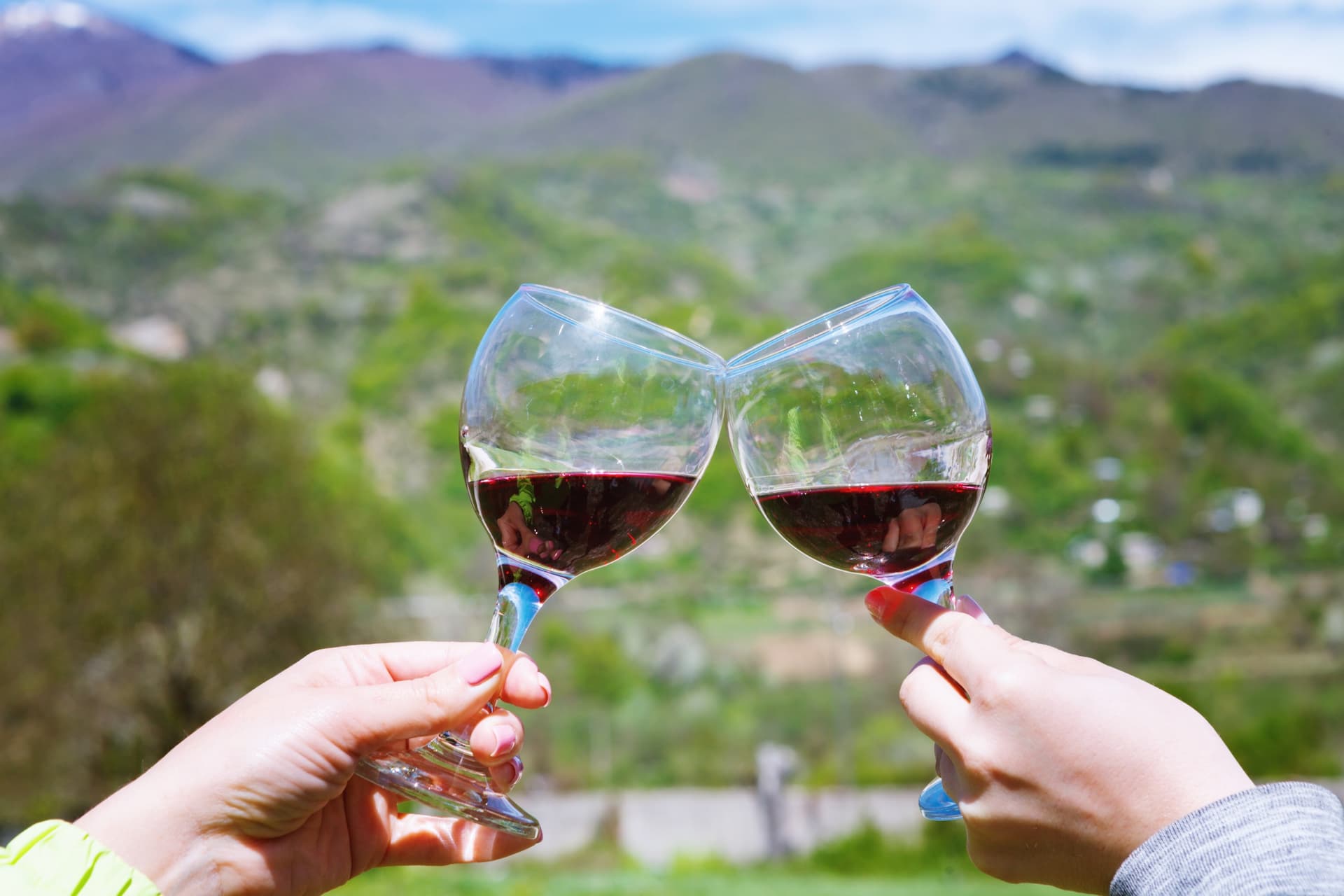
- Taste a semi-dry appellation red wine produced exclusively in this micro-zone, made from the indigenous grape varieties Aleksandrouli and Mujuretuli.
- Witness the oldest of the region's four wineries operating in the village itself.
- Understand the tradition of the kvevri, that characteristic Georgian buried amphora, here featured in smaller formats.
- Enjoy an authentic rural setting along the right bank of the Rioni River, midway between mountain and vineyard.
History of Khvanchkara wine
The wine was first produced in 1870 by Prince Dmitry Kipiani (1814-1887), a writer and figure of Georgian liberal nobility. It was then called "Kipiani wine." Its reputation spread rapidly throughout the Kutaisi governorate and across the entire Caucasus.
The "Khvanchkara" appellation gained prominence later. Local tradition holds that it was chosen by Joseph Stalin, for whom this wine was said to be a favorite. Large-scale distribution dates to the Soviet era, when sweet wines were particularly appreciated in the USSR. Khvanchkara wine reportedly won several gold and silver medals at international competitions.
Georgia today has 6 major wine regions and 18 appellations, with the Ratscha region holding a special place: it is the birthplace of the country's naturally sweet and semi-dry wines.
The village and production
Khvanchkara extends over approximately 903 hectares, from the hamlet of Tsesi to that of Kvishara, along the right bank of the Rioni River. The village is home to nearly 700 inhabitants, many of whom still make their living from the vine.
Wine is produced in four wineries across the region; the oldest is located in the village itself. Alongside this industrial production, several families maintain artisanal winemaking in kvevris, those earthenware amphoras buried underground. In Ratscha, the kvevris are smaller than those found elsewhere in Georgia, a local particularity.
Grape varieties and profile
- Blend: Aleksandrouli and Mujuretuli, plus approximately 5% Saperavi which adds color.
- Harvest: late October, when grapes have accumulated sufficient sugar.
- Color: deep ruby.
- Aromas: raspberry, cherry, ripe plum.
- Analysis: 10.5 to 12% alcohol, 3 to 5% residual sugar, acidity of 5 to 7%.
At table, the simplest local pairing remains lobiani, bread filled with beans, sometimes topped with the region's smoked ham.
When to visit
The micro-zone sits on the southern slope of the Lechkhoumia chain, between 450 and 475 m altitude. The climate is humid, with moderately cold winters and hot, dry summers. Annual sunshine reaches 1900 to 2000 hours.
- May to June: lush vegetation, green landscapes, pleasant conditions for hiking among the vines.
- September to mid-October: the most interesting period, with autumn colors and the approach of harvest.
- Late October: rtveli, the harvest; some families open their cellars to visitors.
- Winter: access can be difficult depending on mountain weather conditions.
Practical information
- Visit duration: allow 1 to 2 hours for a tasting, a half-day if you combine several cellars in the valley.
- Tastings: available at the Khvanchkara winery as well as in several family-run cellars in the village and Ambrolauri.
- Accommodation: guesthouses in Ambrolauri, 12 km away, plus a few homestay options in nearby villages.
- Tasting budget: moderate, with significant variation depending on whether you choose an artisanal cellar or a more formal tasting experience.
How to get there
Khvanchkara is approximately 20 minutes' drive from central Ambrolauri.
- By car from Tbilisi: approximately 4.5 hours, via Nakerala Pass or the route passing through Lake Shaori.
- By minibus: regular departures from Kutaisi and from Didube station in Tbilisi toward Ambrolauri; modest fares, allow time for the journey.
- By air: Ambrolauri has a small regional airport that opened in 2017, served by domestic flights.
- By train: the nearest station is at Tkibuli, 40 km south of Ambrolauri; you then need to continue by minibus or taxi.
- On site: taxis available at the roundabout near Ambrolauri bridge; the center is walkable.
What to see nearby
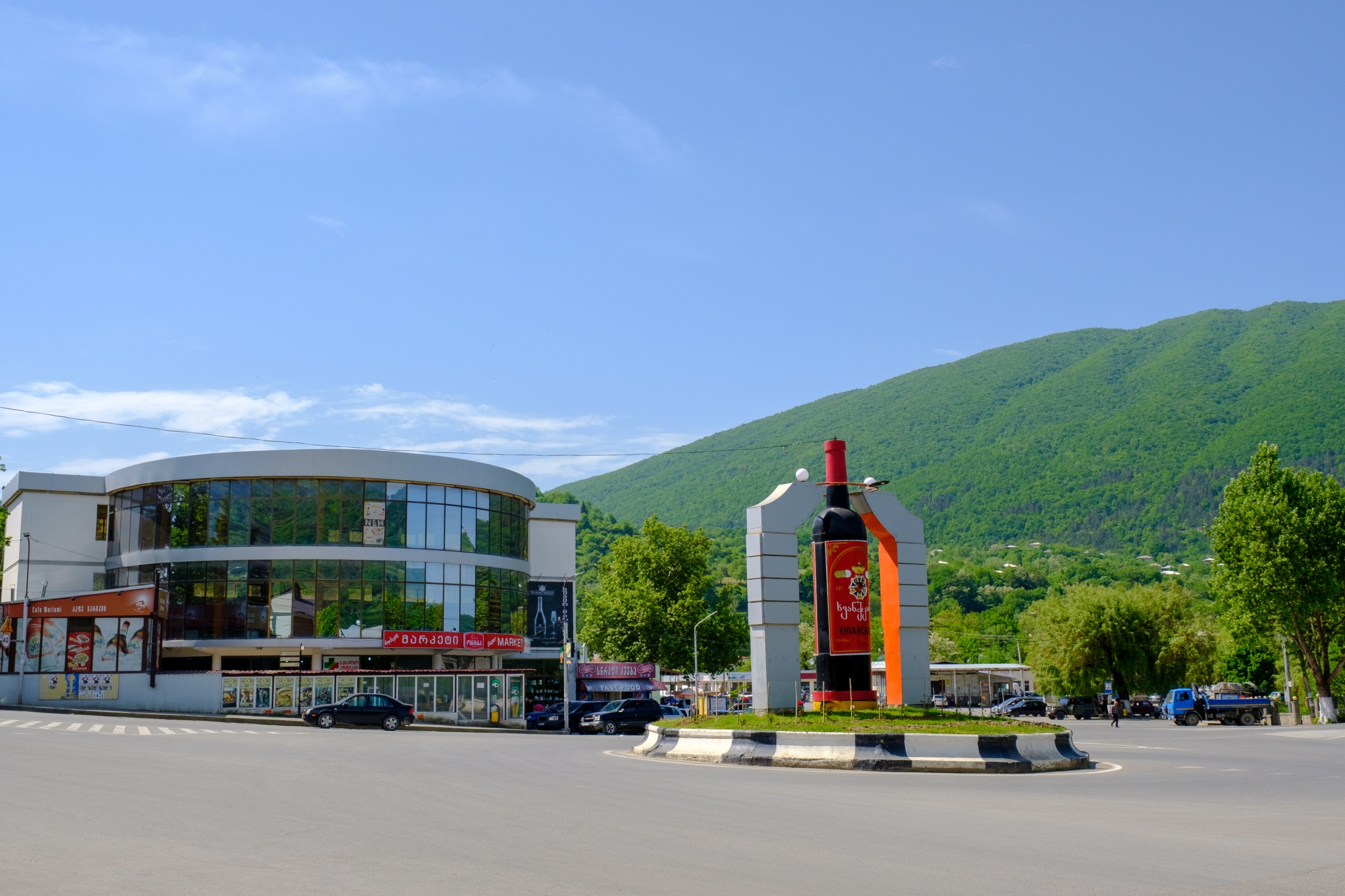
Ambrolauri, founded in the 17th century, is the capital of Ratscha-Lechkhoumia and Kvemo Svaneti. The town center is marked by a monument shaped like a Khvanchkara wine bottle, placed in the middle of a roundabout. The city also houses an art museum, a theatre, and the ruins of an ancient Imereti royal residence.
To extend your stay in western and central Georgia, several sites lend themselves well to an itinerary:
- The Prometheus Cave, accessible from Kutaisi.
- The Gelati Monastery, a UNESCO World Heritage site.
- The open-air ethnographic museum in Tbilisi to understand Georgian rural architecture.
Frequently asked questions
Frequently asked questions
It is a naturally semi-dry appellation red wine made from the indigenous grape varieties Aleksandrouli and Mujuretuli, with approximately 5% Saperavi. It contains 10.5 to 12% alcohol and 3 to 5% residual sugar.
Yes. The village is home to the oldest of the region's four wineries, and several families offer tastings. Cellars in Ambrolauri and neighboring hamlets round out the options.
May through mid-October, with particular interest in late September and October, the period of ripening and then harvest (rtveli, late October).
The easiest option is by car, approximately 4.5 hours via Nakerala Pass or Lake Shaori. Alternatively, minibus from Didube station toward Ambrolauri, then taxi for the final 12 kilometers.
Originally called "Kipiani wine" after its creator, it was later renamed after the village where it is produced. According to tradition, it was Joseph Stalin, a great enthusiast of this wine, who imposed this appellation.
Planning the rest of your trip
Khvanchkara naturally fits into an itinerary combining vineyards, monasteries, and mountain villages. To build your custom journey, explore our Georgia tours.
Interested in this visit?
We can include it in your personalised itinerary.