David Garedja Monastery
David Garedja Monastery
Semi-troglodytic monastic complex founded in the 6th century on the border between Georgia and Azerbaijan, renowned for its medieval Udabno frescoes.
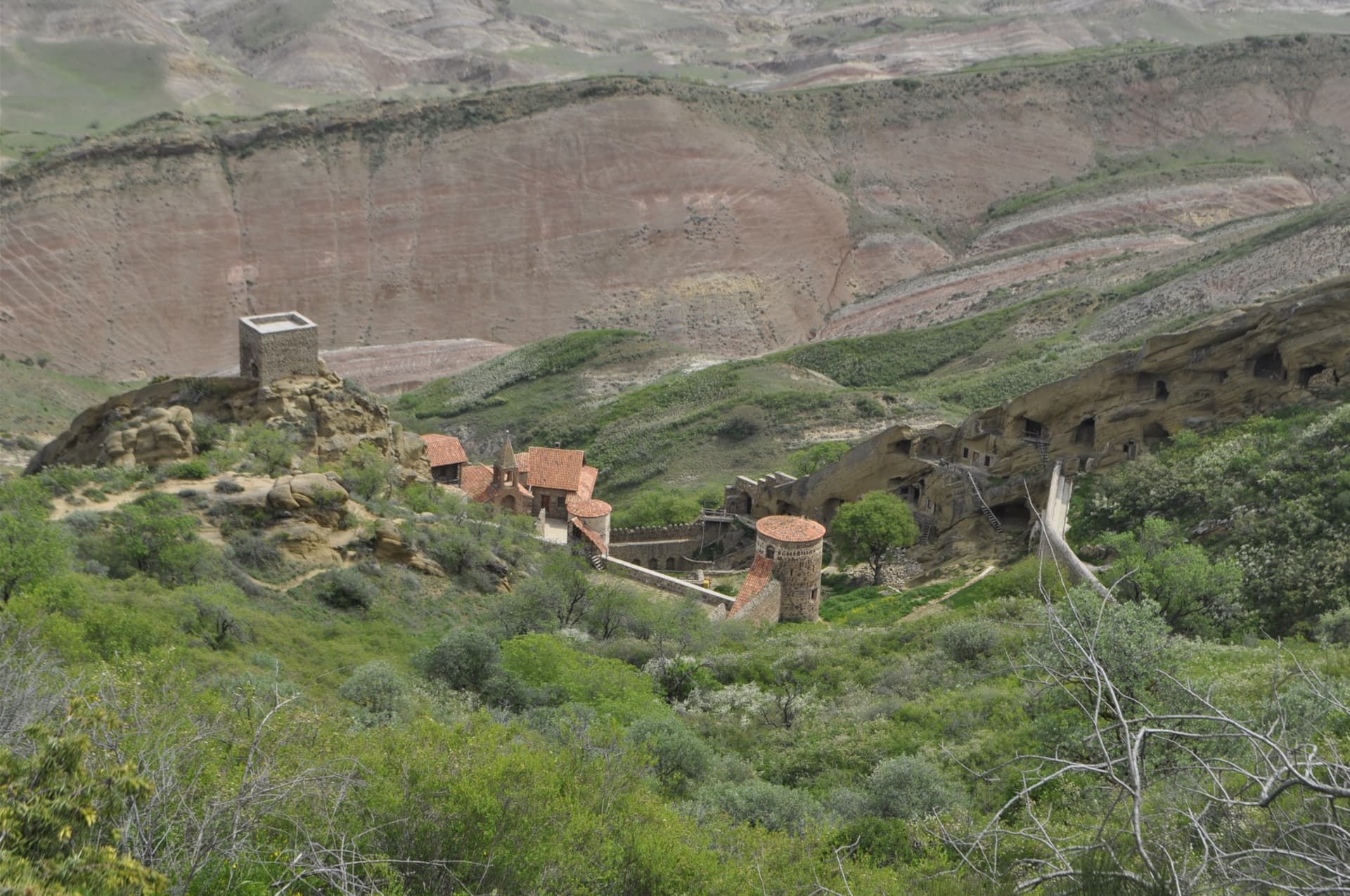
The David Garedja Monastery (sometimes spelled David Gareja) is a semi-troglodytic Eastern Orthodox monastic complex in southeastern Georgia, carved into the arid slopes of Mount Gareja. Founded in the 6th century, it stretches for several kilometres along the contested border between Georgia and Azerbaijan, approximately 70 km from Tbilissi.
Why visit David Garedja
Few sites in Georgia bring together so many layers of interest across a single territory: an Eastern Christianity predating the schism, rock-cut architecture hewn directly into sandstone, still-legible medieval frescoes, and a unique semi-desert steppe landscape in the Caucasus. The complex also offers insight into how Georgian monasticism took root in rock, much like other troglodytic ensembles throughout the country.
Its distance from Tbilissi discourages mass tourism: visitors discover a hushed site, minimally developed, where hiking between the different lavras (monastic complexes) remains the primary activity.
History and foundation
Tradition attributes the monastery's founding to Saint David of Gareja, one of the Thirteen Assyrian Fathers who came to evangelise Georgia in the 6th century. Hagiographic legend holds that he carved the first cells into the rock himself; historical sources emphasise chiefly his role as founder and guiding figure of Georgian monasticism.
The complex reached its cultural and religious zenith in the 11th and 13th centuries, becoming a major intellectual hub of the Georgian kingdom: scriptoria, school of mural painting, communities of monk-scholars. Pillaged by the Mongols in the 13th century, then devastated by the Safavid Persians in the 17th century (an episode known as the "Easter night" of 1615), it underwent intermittent restoration before suffering damage during the Soviet era due to use as a military training zone.
The site is today on the tentative list for UNESCO World Heritage status on the Georgian side, a preliminary step towards potential full inscription.
What to see on site
David Garedja is not a single monastery but a complex of around twenty lavras scattered across the slopes of Mount Gareja. Two of them concentrate the bulk of the visit.
The main lavra (Lavra of David)
This is the historical heart of the complex, still occupied by an active monastic community. You can see the grotto attributed to Saint David, a multi-level church, cells carved into the cliff face, a refectory, and the founder's tomb. The ensemble rises in steps across the natural terraces of the relief.
Udabno and its frescoes
Located higher up on the border ridge, the Udabno lavra preserves roughly a dozen caves adorned with polychrome frescoes dated to the 10th-13th centuries. These wall paintings depict biblical scenes, portraits of Georgian sovereigns, and hagiographic cycles. It is one of the rare ensembles of medieval rock painting preserved in the Caucasus.
The other lavras
Bertubani, Chichkhituri, and Dodos Rka round out the complex; some lie on the Azerbaijani side and remain inaccessible depending on border relations.
Practical information
- Site access: free for the main lavra, no formal ticketing.
- Dress code: shoulders and knees covered to enter religious spaces; headscarf recommended for women.
- Visit duration: allow 2 to 3 hours for the main lavra and ascent to Udabno (trail roughly 1 hour round-trip, moderate elevation gain).
- Water and supplies: no water sources or restaurants on site. Bring water, a hat, and sturdy footwear.
- Border: the ridge trail runs along the border with Azerbaijan; the situation may evolve, best to check before departure.
When to go
The best period spans spring through autumn, with preference for April-June (flowering steppes, mild temperatures) and September-October. Summer is very hot and exposed: the semi-desert steppe offers little shade and temperatures can exceed 35 °C.
In winter, the access track often becomes impassable after rain or snow, and many operators suspend excursions from November to March.
How to get there from Tbilissi
The monastery lies approximately 70 km southeast of Tbilissi, roughly 2 hours' drive, with the last stretch on unpaved track.
- Organised excursion: the simplest option, typically a full day, with stops in Sighnaghi or the Gareja valley.
- Marshrutka (minibus): seasonal departures from Liberty Square in Tbilissi, in the morning, returning early afternoon.
- Private taxi: possible for the day, negotiate in advance with waiting time on site.
- Rental car: a high-clearance vehicle is recommended for the final kilometres.
Nearby
David Garedja combines well with other religious and cultural sites across the country:
- The Bodbe Monastery, near Sighnaghi, on the return route toward Kakheti.
- The Ghélati Monastery, another beacon of medieval Georgian monasticism.
- The Prometheus Cave, to further explore Georgia's underground realm.
- The Tbilissi open-air ethnographic museum, useful for contextualising the country's rural architecture.
Plan your trip
David Garedja fits naturally into an itinerary combining Tbilissi and wine-producing Kakheti. To craft a bespoke journey, explore our Georgia trips.
Interested in this visit?
We can include it in your personalised itinerary.