Alaverdi Cathedral
Alaverdi Cathedral
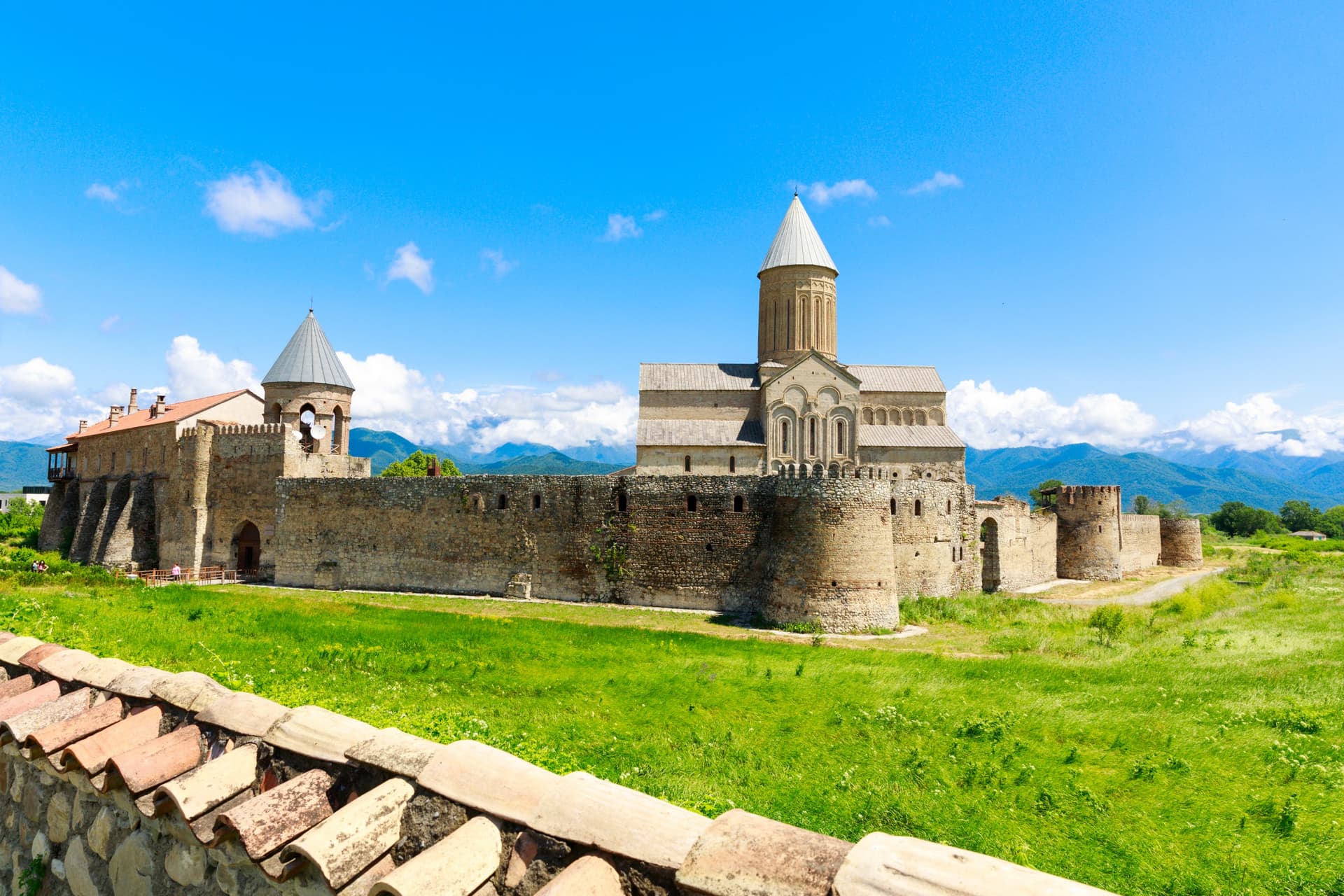
An 11th-century edifice standing 50 meters high, rising from the wine-growing Alazani plain, Alaverdi Cathedral preserves medieval frescoes and maintains an active monastic community.
Alaverdi Cathedral stands in the Alazani plain, in eastern Géorgie, within the wine region of Kakheti. At 50 meters in height, it was long among the country's tallest religious structures, now surpassed by Tbilissi's Sameba Cathedral. Its 11th-century architecture and medieval frescoes make it one of the major monuments of Georgian Orthodox heritage.
Why visit Alaverdi Cathedral
The site offers multiple interests for visitors to Kakheti:
- A fortified 11th-century edifice standing 50 meters high, once among the country's tallest structures
- Partially restored medieval frescoes, including a Virgin and Child and Saint George slaying the dragon
- A location in the Alazani plain, surrounded by the vineyards that have made Kakheti's reputation
- An active monastic community, with the edifice occupied by a congregation of monks
- Alaverdoba, an annual religious festival that gathers the faithful from across the region around September 14
History of the cathedral
The site's origins date back to the 6th century, when an Assyrian monk from Antioch, Joseph Alaverdi, founded a first monastery. He was among the Thirteen Assyrian Fathers who came to evangelize Géorgie, and certain parts of the current edifice still date from this ancient period.
The cathedral as seen today was built in the 11th century by Kviriké, king of Kakheti, at the site of the original monastery. Its monumentality reflects the dynamism of the unified Georgian kingdom under David IV the Restorer, whose political and religious authority it embodied.
The name "Alaverdi" is of Turco-Persian origin: Allah verdi literally means "given by God". It testifies to Kakheti's linguistic contacts with neighboring powers over the centuries.
The monument has endured several earthquakes that damaged its structure. In the 19th century, under Russian rule, the Georgian medieval frescoes were whitewashed, following the practices of the time aimed at standardizing the decoration of Orthodox churches. A partial restoration undertaken in 1966 allowed for the recovery of many of these wall paintings.
What to see on site
Exterior architecture
The complex is enclosed within a fortified wall and organized according to a cross plan extended by three rectangular apses. Like most religious monuments in Kakheti, the exterior decoration remains sober, emphasizing the massive volumes and verticality of the dome.
Interior and frescoes
The interior space impresses with its height and luminosity. The dome is pierced by 16 windows that amplify the sense of space and diffuse soft light throughout the nave.
Several frescoes merit attention:
- The Virgin and Child, located above the altar, which represents the oldest painting preserved on the site
- Saint George slaying the dragon, above the western portico, a tutelary figure of Georgian Christianity
- The fragments restored in 1966, which provide insight into the original iconographic program
The active monastery
The complex is today reoccupied by a monastic community. A visit therefore requires respecting the daily functioning of the site and avoiding areas reserved for the monks.
When to visit
Kakheti is best visited from May to October in pleasant conditions, with agreeable temperatures and wine region landscapes at their peak in late August-September, the harvest season.
The most significant date is Alaverdoba, an annual religious celebration beginning around September 14 and extending for nearly three weeks. This festival has for centuries gathered the faithful from across Kakheti, regardless of denomination, and coincides with the harvest period. It is when the cathedral returns to its historical function as a regional spiritual center.
Winter is harsher: the Alazani plain can be cold and humid, and certain parts of the site are less pleasant to visit.
Practical information
- Dress code: as the cathedral is an active monastery, modest clothing is required. Women must cover their hair with a headscarf (often available at the entrance) and wear a skirt; men avoid shorts
- Photography: generally prohibited inside; confirm on-site
- Duration of visit: allow 45 minutes to 1 hour for the complex
- Admission: free, as with most Georgian monasteries
- Hours: open during the day, with a possible break midday; check locally
How to get there
The cathedral is located approximately 20 km northwest of Telavi, the regional capital of Kakheti, and about 110 km from Tbilissi.
- From Tbilissi: plan for 2 to 2.5 hours of driving. The simplest solution remains a car (rental or private driver), allowing you to visit several Kakheti sites in one day. Marshrutkas (shared minibuses) connect Tbilissi to Telavi
- From Telavi: taxi or marshrutka for the 20 km separating the city from the site, approximately 30 to 40 minutes of travel
- On an organized tour: most Kakheti circuits include Alaverdi alongside other sites such as Ikalto, Gremi or tastings at wine estates
Nearby attractions
Kakheti concentrates several sites that combine easily with Alaverdi:
- Telavi, the regional capital, with its fortress and old lanes
- Ikalto, a 6th-century monastic complex that was a major center of medieval Georgian learning
- Gremi, a former royal capital whose citadel dominates the plain
- The wine estates of the Alazani plain, where you taste traditional varieties such as saperavi and rkatsiteli
Lovers of Georgian religious architecture will extend their discovery with the Ghélati Monastery, another spiritual landmark of the country, or the Narikala Fortress in Tbilissi.
Frequently asked questions
It is situated in the Alazani plain, in Kakheti, approximately 20 km northwest of Telavi and 110 km east of Tbilissi.
The name is of Turco-Persian origin: Allah verdi literally means "given by God". It testifies to the linguistic influences of neighboring regions on the area.
The celebration begins around September 14 and extends for nearly three weeks. It traditionally gathers the faithful from across Kakheti, regardless of denomination.
As the site is an active monastery, modest clothing is required. Women cover their hair with a headscarf and wear a skirt; men avoid shorts. Headscarves are sometimes provided at the entrance.
Yes, the cathedral integrates well into a one-day itinerary in Kakheti including Telavi, Ikalto, Gremi and tasting at a wine estate in the Alazani plain.
Plan your trip to Géorgie
Alaverdi Cathedral is part of a natural circuit for discovering Kakheti, a wine and monastic region in the country's east. To build an itinerary combining Orthodox heritage, tastings and landscapes, explore our tailor-made Géorgie trips.
Interested in this visit?
We can include it in your personalised itinerary.