Mtskheta
Mtskheta
Just 20 km from Tbilisi, Mtskheta concentrates Georgia's most precious religious heritage: three UNESCO sites, thousand-year-old monasteries, and a spectacular view over the confluence of the Aragvi rivers.
Mtskheta, a city listed as a UNESCO World Heritage Site, is essential for those seeking to discover the cradle of Georgian Christianity.
Nestled within a picturesque setting, this city ranks among Georgia's oldest.
The striking Svetitskhoveli Cathedral, standing 54 meters high, is one of its principal attractions. This cathedral exemplifies the flourishing of Christian architecture in Georgia.
A closer look at one of Georgia's most cherished cities.
A Dive into Mtskheta's History
Mtskheta, situated in eastern Georgia, approximately 20 km from Tbilisi, is one of the country's oldest cities. From the 3rd century B.C. to the 5th century A.D.—nearly 800 years—it remained the capital of the Kingdom of Iberia.
King Dachi Je Ujarmeli, successor to Vakhtang I Gorgasali, relocated Georgia's capital to Tbilisi in the early 6th century A.D.
Yet coronation ceremonies and the funerals of Georgian kings continued to be celebrated in Mtskheta until the kingdom's end in the 19th century.
Today, the city serves as the administrative center of Mtskheta-Mtianeti region.
The city holds tremendous significance for Georgians. Indeed, Christianity began establishing itself here in 337 A.D., when it was officially proclaimed the state religion.
Since the 4th century, Mtskheta has housed the seat of the Georgian Apostolic Orthodox Church.
It was also in Mtskheta that "the Revealer," Saint Nino, came to convert the Queen of Iberia to Christianity.
Georgia thus became one of the earliest nations to embrace Christianity.
In terms of growth, Mtskheta owes its prosperity to favorable natural conditions and a strategic geographical position. The city sits at the crossroads of Georgian trade routes. Close ties between Mtskheta and Syria, Persian and Roman empires, Byzantium, as well as Palestine further contributed to the city's development. These strong connections enabled Mtskheta to benefit from diverse cultural influences, reflected today in local traditions.
Mtskheta Today
In ancient times, Mtskheta was renowned as an important pagan city.
It represents today the "spiritual capital" and the home of Georgia's two greatest churches, Djvari and Svetitskhoveli.
In 2014, Mtskheta was declared a "Holy City" by the Catholicate-Patriarchate of Georgia.
Today, make the most of your stay in Mtskheta by strolling through narrow streets lined with artisanal shops and traditional restaurants.
This is your chance to taste the national dish, called "adjarian khachapuri." It consists of hollowed bread topped with melted cheese and an egg.
Mtskheta's Attractions
Religious Sites:
Numerous historical monuments in Mtskheta have earned spots on the UNESCO World Heritage list, including religious structures.
Svetitskhoveli Cathedral (11th century), Djvari Monastery of the Holy Cross (6th century), and Samtavro Monastery are notable religious monuments of medieval Georgia.
The first monument to visit is Svetitskhoveli Cathedral. Entrance to the cathedral is free.
It was founded in 1010 on the site of Georgia's first basilica. For centuries, this cathedral served as a burial place and coronation site for Georgian kings.
Thus, the tomb of King Vakhtang Gorgasali, the founder of Tbilisi, lies within the cathedral.
You'll also find a bell tower, a gate, fortresses, and residences.
This masterpiece of Georgian architecture has been Georgia's religious center for centuries. Indeed, it remains a sacred place in Georgia to this day.
It is believed to house the tunic of Jesus Christ, brought in the first century by the prophet Elios, a Jew native to Mtskheta.
After visiting Svetitskhoveli Cathedral, head to Djvari Monastery, also called the Monastery of the Cross.
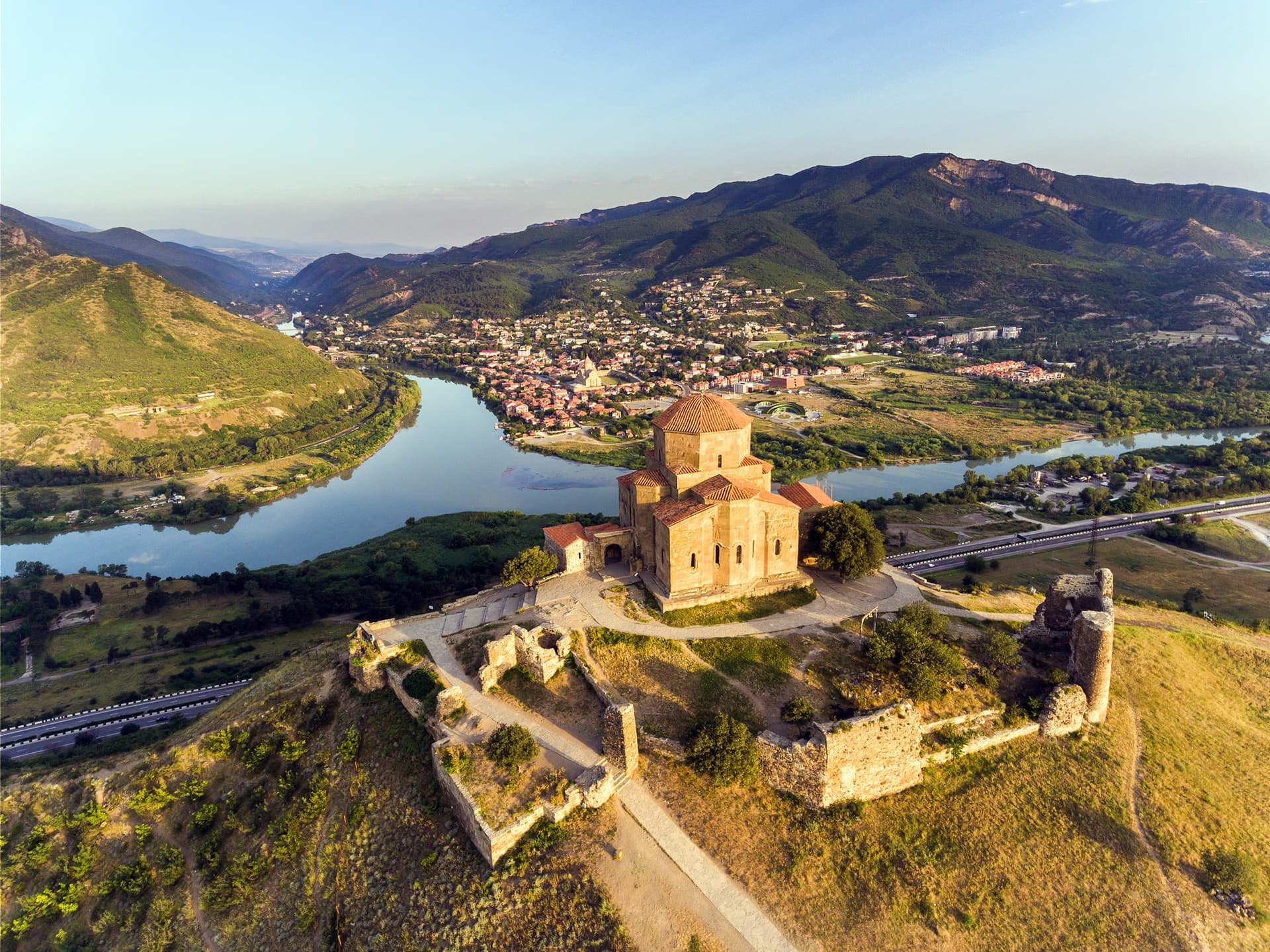
Perched on a rocky outcrop, it dominates the entire city, offering visitors a breathtaking view of the Aragvi and Mtkvari rivers.
This monastery's history is closely tied to Saint Nino.
According to legend, when Saint Nino succeeded in converting King Mirian III to Christianity, she had a wooden cross built that worked miracles. Today, a small chapel stands on the remains of this cross.
The best time to visit this monastery is during clear weather. To reach the site, a taxi is your best option, costing around 20 GEL.
A few minutes' walk from the Svetitskhoveli complex, in the center of Mtskheta, stands Samtavro Monastery, dating from the 4th century. This monastic complex houses two churches.
The smaller chapel, built in the 4th century, was where Saint Nino lived and regularly preached.
The larger church, constructed in the 11th century, contains the tombs of the last pagan monarchs. You'll notably find the tombs of King Mirian and his wife, Queen Nana. He was among Georgia's first Christian kings.
Today, this monastery has been transformed into a convent housing nuns.
Historical Sites:
Beyond its churches and monasteries, Mtskheta holds many other historical treasures, starting with Brebis Tsikhe Fortress. Entrance is free.
This fortress sits upstream along the main road leading from Samtavro Monastery.
The fortress ruins are worth exploring. From the top of the structure, you'll enjoy a panoramic view of the city.
Continue your visit with Chio Cave, founded by one of the 13 Syrian monks (Chio) who came to Georgia in the 6th century to convert Georgians to Christianity.
Thanks to the many miracles he performed during his lifetime, he was canonized by the Georgian Church. He is even called the "father of all fathers."
The site contains various structures dating from the 6th to 12th centuries, built to accommodate religious worship. The cave of Monk Chio, which is very dark, is particularly worth visiting.
He lived there for about twenty years and was even buried there.
Archaeological Sites:
As capital of the Iberian Kingdom during the 5th century, Mtskheta also boasts a rich archaeological heritage.
Among the city's valuable archaeological remains is the museum-reserve. It houses artifacts dating from the Bronze Age and the Middle Ages, as well as ethnographic objects.
North of the city, on the right bank of the Aragvi River, lies Bebristsikhe Fortress.
During antiquity, this castle was called Belta. Its total area spans approximately 1,500 m². Its inner courtyard covers 600 m².
Following the Mtskheta-Tbilisi highway, you'll discover the Armaztsikhe (Bagineti) archaeological site, dating from the 3rd century B.C. Its name is linked to the pagan idol Armazi.
King Parnavaz had proclaimed it a supreme deity.
Archaeological discoveries on the site include wall fragments, royal residence structures, towers, and remains of a funerary church.
Given its size, occupying approximately 30 hectares, Armazi ranks among Georgia's most important fortresses. It was used to control trade routes to countries bordering the Caucasus.
Also take the opportunity during your stay in Mtskheta to visit the remains of the Acropolis dating from the 1st millennium B.C.
What's the Weather Like in Mtskheta?
A warm temperate climate dominates Mtskheta, with substantial rainfall, even during the driest period of the year.
Mtskheta averages 23.3°C annually, with average precipitation of 557 mm.
July is the warmest month of the year. Temperatures rise throughout the month, particularly during daytime. Early in the month, they range from 24-25°C, reaching 30-31°C by month's end.
At night, temperatures range from 11-12°C early in the month to 13-14°C by the end.
In July, weather is mostly clear or partly cloudy.
January is the coldest month of the year. During this period, the average temperature is 0.9°C.
Moreover, July and August are the best months to visit Mtskheta-Mtianeti.
Getting There
By Bus:
The simplest and most economical way to reach Mtskheta is by public transport.
Minibuses are stationed at the Didube Market in Tbilisi to take you to the old town of Mtskheta.
Daily connections run regularly. A one-way ticket costs just 1 lari per person.
By Taxi:
You can also rent a taxi from Tbilisi center or Didube Market for a half-day, solo or with others. This can prove both convenient and economical.
On Sundays, due to increased visitor numbers, this mode of transport becomes less frequent.
By taxi, expect to pay around 20 lari for the day. This rate, the standard fare, includes a round trip, waiting time on-site, and optionally—after negotiation—a trip up to Djvari Monastery. The panorama is truly worth it.
To ensure your return to Tbilisi, it's important to take the taxi company's phone number before departing for Mtskheta.
Mtskheta is a small city. It's therefore possible to explore it on foot.
However, if you plan to visit Djvari Monastery, located outside the town center, it's better to take a taxi.
Want to discover this destination?
Our local advisors design your tailor-made trip.