Ikalto Monastery and Academy
Ikalto Monastery and Academy
Seven kilometers from Telavi, the Ikalto complex brings together a 6th-century monastery and the remains of a medieval academy, one of Georgia's great cultural centers.
Seven kilometers west of Telavi, in the valley of the Gombori Mountains, the Ikalto complex combines a 6th-century monastery and the remains of a medieval academy that was, alongside Gelati Academy in Imereti, one of two major intellectual centers of medieval Georgia. The site, surrounded by cypress trees, makes an excellent complement to a wine-focused stay in Kakheti.
Why visit Ikalto
Ikalto brings together three distinct attractions rarely found on a single Georgian site:
- A monastery founded in the 6th century by Zeno of Ikalto, one of the 13 Syrian Fathers who came to evangelize Georgia, where he spent his final years and was buried.
- An academy founded in the 11th-12th centuries by the philosopher Arsen of Ikalto, tutor to King David the Builder, where the poet Shota Rustaveli is said to have studied.
- A remarkably broad educational curriculum: geography, rhetoric, religion, astronomy, philosophy, geometry, theology, and also ceramics, viticulture, and winemaking—disciplines confirmed by archaeological excavations.
The village of Ikalto, first mentioned in the 6th century, is one of the oldest inhabited settlements in Kakheti.
History of the site
The monastery was established in the 6th century around the community of Zeno of Ikalto. Several centuries later, the complex gained new prominence when Arsen of Ikalto founded an academy there in the 11th-12th centuries. The site then became a major center for the transmission of sciences and letters, comparable to Gelati Monastery in Imereti.
In 1616, troops of Shah Abbas I of Persia devastated Kakheti and severely damaged Ikalto. The academy never recovered: its buildings remained in ruins, while the churches were partially preserved. Modern excavations have uncovered, among the academy remains, the tombs of Zeno of Ikalto and Arsen of Ikalto, as well as a wine cellar and several workshop rooms that shed light on daily life at the complex. A restoration undertaken in 2010 focused on the main church.
What to see on site
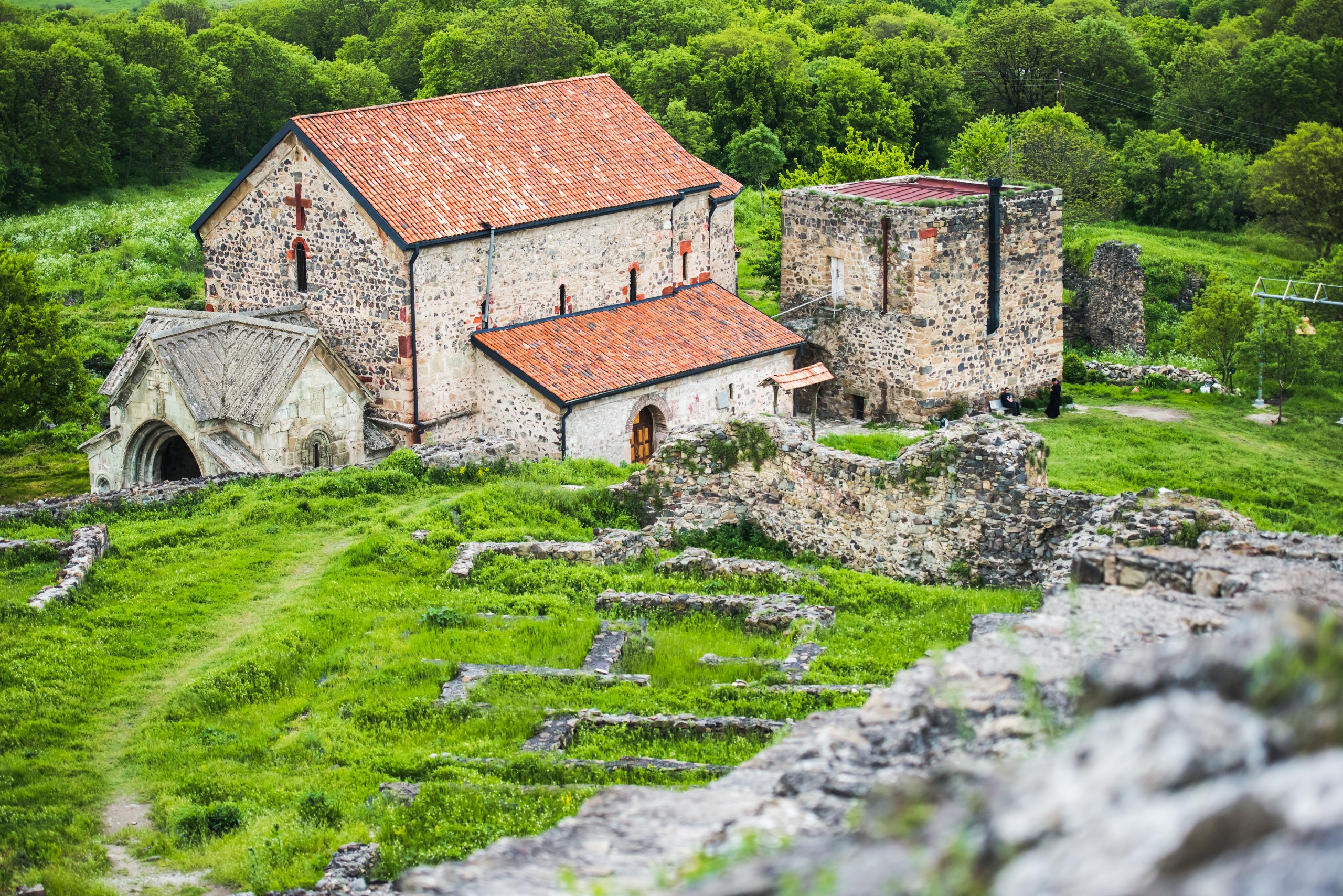
The complex consists of three churches and the remains of the academy.
Khvtaeba Church (main church)
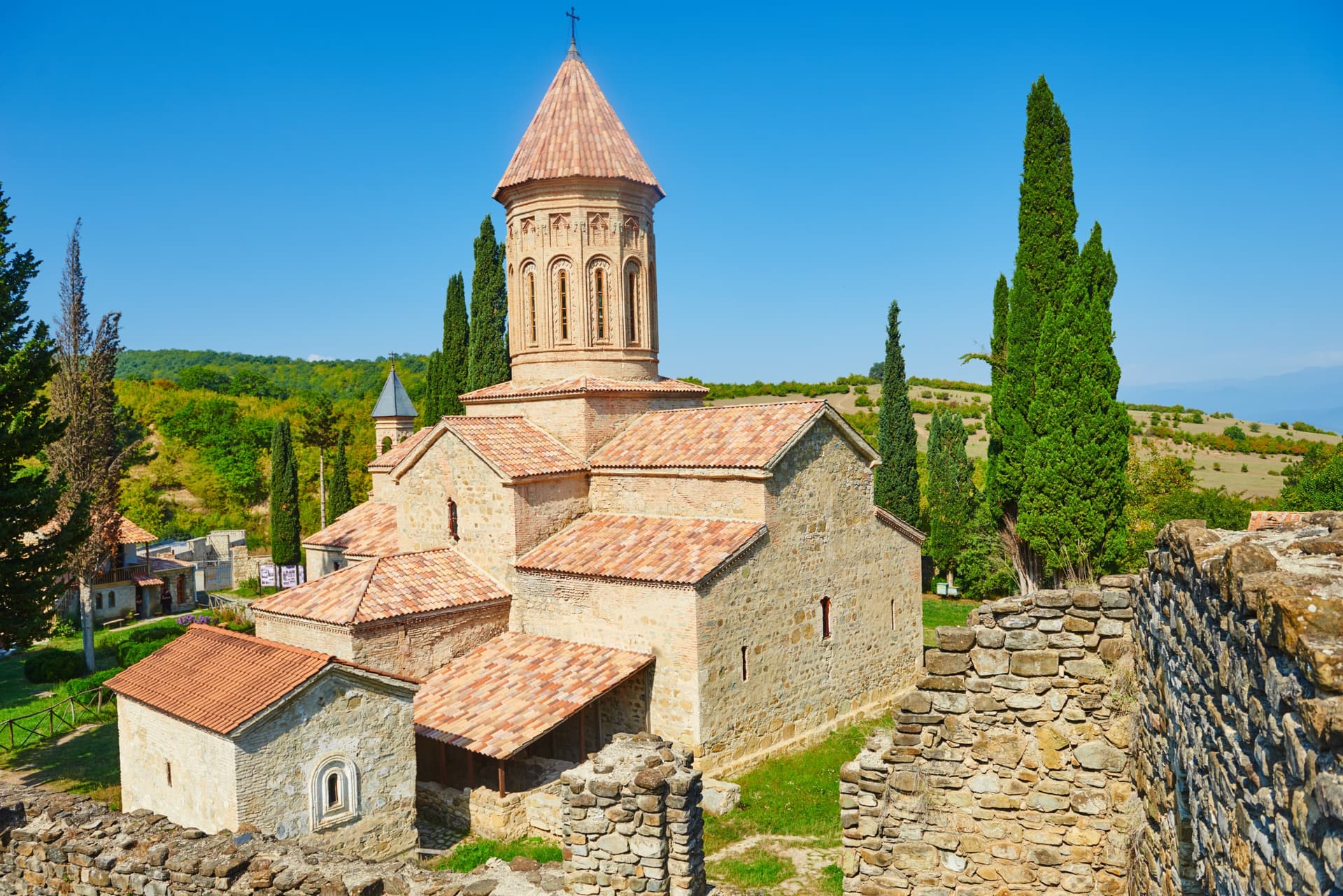
This is the best-preserved structure. Its present form dates to the 8th-9th centuries. It houses the burial of Zeno. Its rectangular exterior plan—while semicircular apses are visible inside—links it to Eastern structures such as those of Kourion (Cyprus). The brick dome visible today was added in the 19th century, when the walls were whitewashed under Russian administration.
Sameba Church (Trinity)
A small 6th-century church located east of Khvtaeba, notable for its crypt. Its porch features an overarching entrance arch—its diameter exceeds the spacing of the pillars supporting it. Above, a carved plaque shows figures with oversized heads, motifs sometimes compared to Celtic art.
Kvelatsminda Church (All Saints)
A single-nave basilica from the 12th-13th centuries, today in ruins but still legible in its main lines.
Academy remains
To the right of the main basilica stand the high walls of the academy, along with the wine cellar and workshop rooms uncovered by archaeologists. These discoveries confirm that viticulture and winemaking were taught here as full disciplines—a distinctive trait of Ikalto, rooted in Kakheti's winemaking tradition.
Practical information
- Access: the site is open to the public year-round, with no entrance fee; a donation to the monastery is appreciated.
- Duration of visit: allow 45 minutes to 1 hour to tour the three churches and academy remains.
- Etiquette: Ikalto is an active monastery. Modest dress is required (shoulders and knees covered), a headscarf for women at church entrances, no photography during services.
- Comfort: few facilities on site; bring water and sturdy shoes, as the ground around the ruins is uneven.
When to visit
Kakheti is pleasant to visit from late April through early November. The months of May-June offer lush vegetation around the site, while September-October coincide with the grape harvest (rtveli)—the ideal period to combine Ikalto with exploring the region's wineries. Winter is possible but mountain roads can be treacherous and shorter daylight limits the visit.
How to get there
The site is 7 km west of Telavi, the regional capital of Kakheti.
- By air: Shota Rustaveli International Airport in Tbilisi is approximately 52 km from Telavi.
- By marshrutka: from Tbilisi, minibuses depart regularly from Ortachala station toward Telavi via Sighnaghi and Gurjaani. From Telavi, local marshrutkas serve Ikalto and the nearby Alaverdi Monastery.
- By car: two routes connect Tbilisi to Telavi (via Gombori Pass or the longer route via Sagaredjo); in winter, the latter is safer.
Nearby attractions to combine
- Telavi, the historic capital of Kakheti, 7 km away, the logical base for exploring the region.
- Alaverdi Monastery, approximately 20 km from Telavi, whose 11th-century cathedral is one of Georgia's tallest medieval churches.
- The Bodbe Monastery, near Sighnaghi, associated with Saint Nino.
- To compare Ikalto with the other great medieval Georgian cultural center, the Gelati Monastery in Imereti, its western counterpart.
Frequently asked questions
Frequently asked questions
Allow 45 minutes to 1 hour to tour the three churches and academy remains. Combined with nearby Alaverdi, plan for a half-day excursion from Telavi.
The site has no entrance fee. A donation to the monastery is appreciated to support the maintenance of the buildings.
Tradition affirms this and it is part of the site's heritage, but no contemporary source about the poet confirms it with certainty. It is a plausible hypothesis given the academy's prominence in the 12th-13th centuries.
The high walls are preserved, along with the wine cellar and several workshop rooms uncovered by excavations. The tombs of Zeno of Ikalto and Arsen of Ikalto have also been found there.
Yes, the site can be visited in a day from Tbilisi, typically combined with Telavi, Alaverdi, and a local winery. An overnight stay allows you to explore Kakheti more fully.
Plan your trip
Ikalto fits naturally into a Kakheti circuit, between medieval religious heritage and traditional wineries. To build a custom itinerary incorporating Telavi, Alaverdi, and the wine region, explore our Georgia travel experiences.
Interested in this visit?
We can include it in your personalised itinerary.