Batumi
Batumi
Capital of Adjaria on the shores of the Black Sea, Batumi blends Belle Époque elegance, contemporary skyscrapers and pebble beaches. Practical guide to planning your stay.
Georgia is one of Europe's most beautiful countries, boasting remarkable tourism potential. Among Georgia's most enchanting cities stands Batumi, a Black Sea resort town nestled on the shores of the Black Sea. Batumi owes its fame to its stunning waterfront and distinctive architecture, harmoniously blending futuristic and historic structures. For those seeking a fresh perspective on Georgia—something truly out of the ordinary—Batumi is an excellent choice for an unforgettable expedition.
Discovering Batumi and Its History
The Greek philosopher Aristotle was among the first to mention the city in the 4th century B.C. It was then known as "Batusi". Bathys, meaning "deep" in Greek, was one of the principal cities of Lazica, an ancient kingdom located in western Georgia during the 1st century B.C.
In the 2nd century, under Emperor Hadrian, a Roman garrison occupied the city. It was in the 5th century that Batumi fell under the control of Vakhtang I of Iberia. From the 6th to 8th centuries, the governors of Abkhazia and Egrisi held dominion over Batumi.
Toward the end of the 11th century, Georgia became a unified nation and the Kingdom of the Kartvelians was established alongside Batumi. Upon the death of sovereign Vakhtang I of Iberia in 1564, Batumi reverted to Turkish territory. The Turks decided to build a fortress there. Unfortunately, the assault by the new King Mamia II in 1609 resulted in defeat for Turkish forces. In 1873, the Turks regained control of the region and made Batumi the principal city of Lazeti.
During the Congress of Berlin, held from June 13 to July 13, 1878, the British established Batumi as a free port. Thanks to this new status, Batumi transformed into a modern city. However, in 1886, it lost its free port designation. It was not until April 28, 1888 that Batumi officially obtained its status as a "city". The early 20th century proved to be a particularly prosperous period for the Batumi region and southwestern Georgia.
Batumi Today
Capital of the autonomous region of Adjaria and Georgia's third-largest city, Batumi is flourishing. It is also one of the Black Sea's most beautiful resort towns. The development of tourism from "novoritchis"—the new post-Soviet Russian bourgeoisie—in Batumi has spurred construction of new casinos and hotels, along with various leisure venues.
The city is sometimes called the "Las Vegas of Georgia" for its numerous casinos and diverse attractions dotting the "Bulvar". To this end, Batumi's boulevard is a privileged destination for both locals and tourists alike. The "Bulvar" features a lovely waterfront, beach, and verdant park for rejuvenation. Strolling along this 8 km boulevard, you'll discover several monuments, including the Ali and Nino sculpture.
What strikes you most upon arriving in Batumi is the harmonious blend between modern architecture and historic buildings constructed during the Soviet era. Today, Batumi presents an eclectic, sometimes quirky aesthetic. Wandering through its historic center, you'll notice that the authentic charm of old Batumi is preserved, despite renovations and the proliferation of modern buildings. Europe Square and its magnificent architectural ensemble are perfect examples.
Batumi's Attractions to Explore
Despite its modest size of 64.9 km², Batumi boasts several major tourist attractions ranging from Notre-Dame Cathedral to Gonio Fortress, passing through its Botanical Garden. Located in southwestern Georgia, it is the largest city in the Achara region, while also serving as Georgia's principal port.
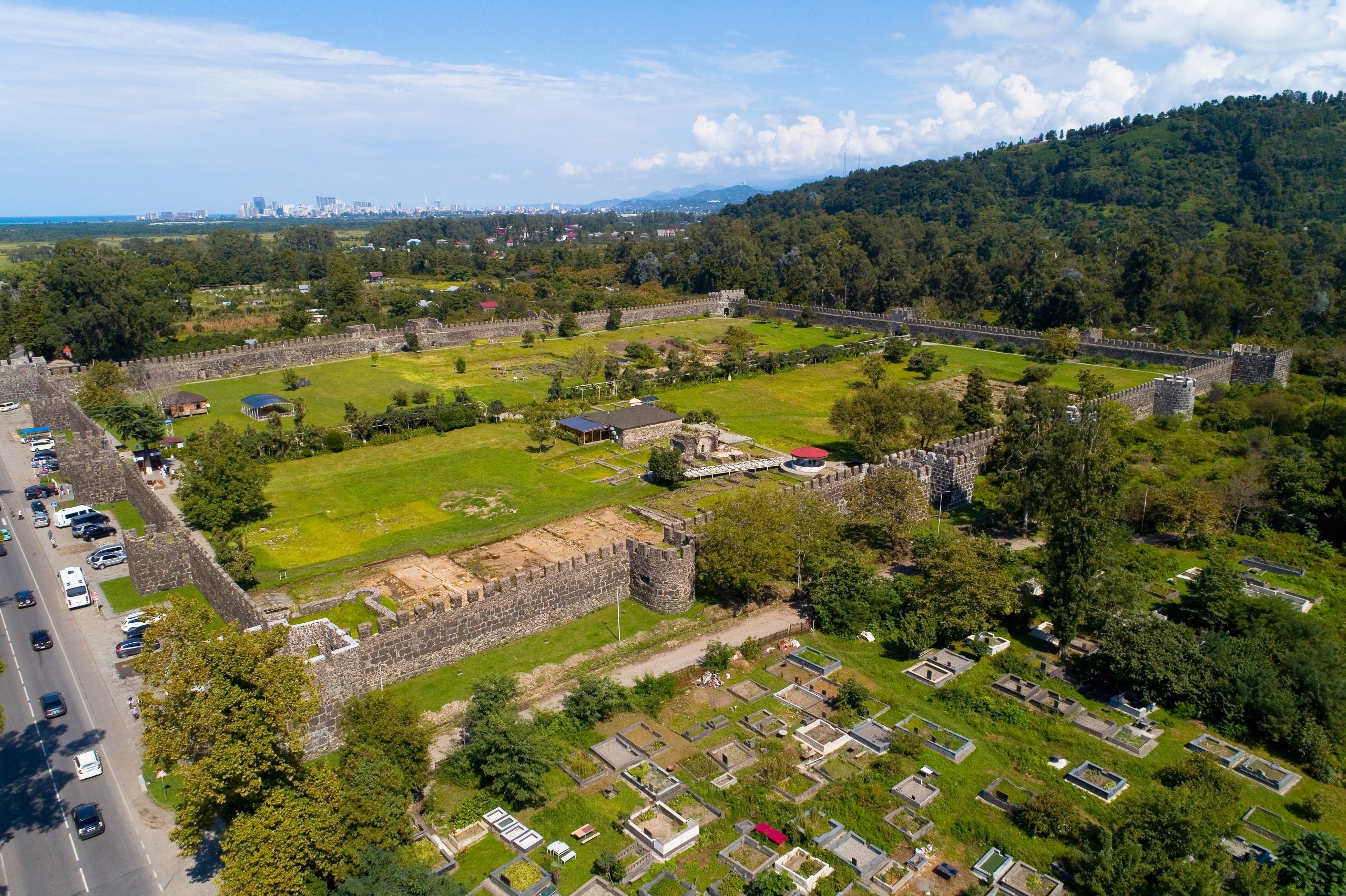
Begin your Batumi exploration with the city's key historical monuments. South of the resort town stands Gonio Fortress, displaying Romano-Byzantine architectural style. The history of this citadel is closely linked to the myth of the Argonauts. However, its name appears only in the 7th century. Archaeological excavations at this site have dated the fortress's existence between the 1st and 3rd centuries.
Notre-Dame Cathedral is another landmark monument worthy of a visit. Its construction dates back to 1902. Above the basilica's main entrance stand the statues of Simon and Andrew, the first Christian missionaries in Georgia. Demolished in 1937, the cathedral was rebuilt in 1989. The architecture of the new building is Gothic in style.
The city's numerous museums are also worth including in your historical and cultural tour, including the Adjarian State Art Museum. In fact, it is a contemporary art gallery exhibiting beautiful paintings by Georgian artists such as Akhvlediani or Gudiashvili.
Also visit the Borjgalo Ethnographic Museum, which chronicles the former way of life of Georgians. Sculptures, paintings, and wood engravings highlight Georgian history and craftsmanship. Sprawling across 3,000 m², this museum also includes plantations, a hiking trail, and a 9-meter artificial waterfall. The waterfall is complemented by a forest valve. The museum opened its doors in June 2016, with an entrance fee of 10 lari.
During the Belle Époque, Batumi developed tremendously thanks to Azerbaijani oil that transited here in the late 19th century. From City Hall Square to Theatre Square, forming a beautiful architectural unit, this represents today the reflection of that development. Indeed, Neptune's Fountain presides over Theatre Square.
Take the opportunity to visit Batumi Theatre, one of the city's most popular venues. Construction began in the 1930s. The theatre features a magnificent marble-patterned classical façade. The auditorium, which is circular in form, can accommodate a maximum of 600 spectators.
Continuing the stroll to Europe Square, discover a restored Old Town. This square was named when Adjaria joined the Assembly of European Regions. It comprises a collection of buildings dating from the late 19th and early 20th centuries. The statue of the mythological Greek figure Medea dominates this square. Still in old Batumi, on Gorgasali Street, near the alcove of a historic house, stands the statue of a boy with a flute. This statue is a true symbol of Batumi.
Yet the city's most emblematic monument remains the "Alphabetic Tower", a tall structure in the shape of a double helix. On its walls are inscribed the 33 letters of the Georgian alphabet. Construction began in 2010, but became operational only toward the end of 2011. This 130-meter-high tower serves as a landmark in the city, as it is visible from afar, day and night. For those wishing to dine, the tower houses a restaurant, as well as an elevator for transport.
However, Batumi is most famous for its Botanical Garden, situated 9 km from the city center. Favored by a humid subtropical climate, this garden spanning 108.7 hectares shelters over 1,700 different species, which comprise the flora of the Adjaria region. Divided into 9 sectors, it features plants from Mexico and the Himalayas, as well as endemic varieties of the Transcaucasus. You will also find various types of wood, such as sakura, bamboo, cactus, Canary palm, magnolias, and palms.
Batumi, the Ultimate Tourist Destination
Georgia's third-largest city and capital of the autonomous region of Adjaria, Batumi has become one of the Black Sea's premier resort towns. This prestigious Georgian coastal city has everything to captivate with its sandy beaches, the warm waters of the Black Sea, and a pleasant subtropical climate. Moreover, cypresses, palms, and magnolias line the city's streets. All these elements make Batumi Georgia's most coveted beach resort.
If you enjoy partying and having fun, Batumi's boulevard is where you need to be. It is lined with restaurants, bars, cafés, cinemas, and more. In Batumi, annual festivals are plentiful, such as the jazz and classical music festival. In autumn, the city hosts the "Batumoba" and "Gandagana" festivals. The latter is dedicated to rural tourism.
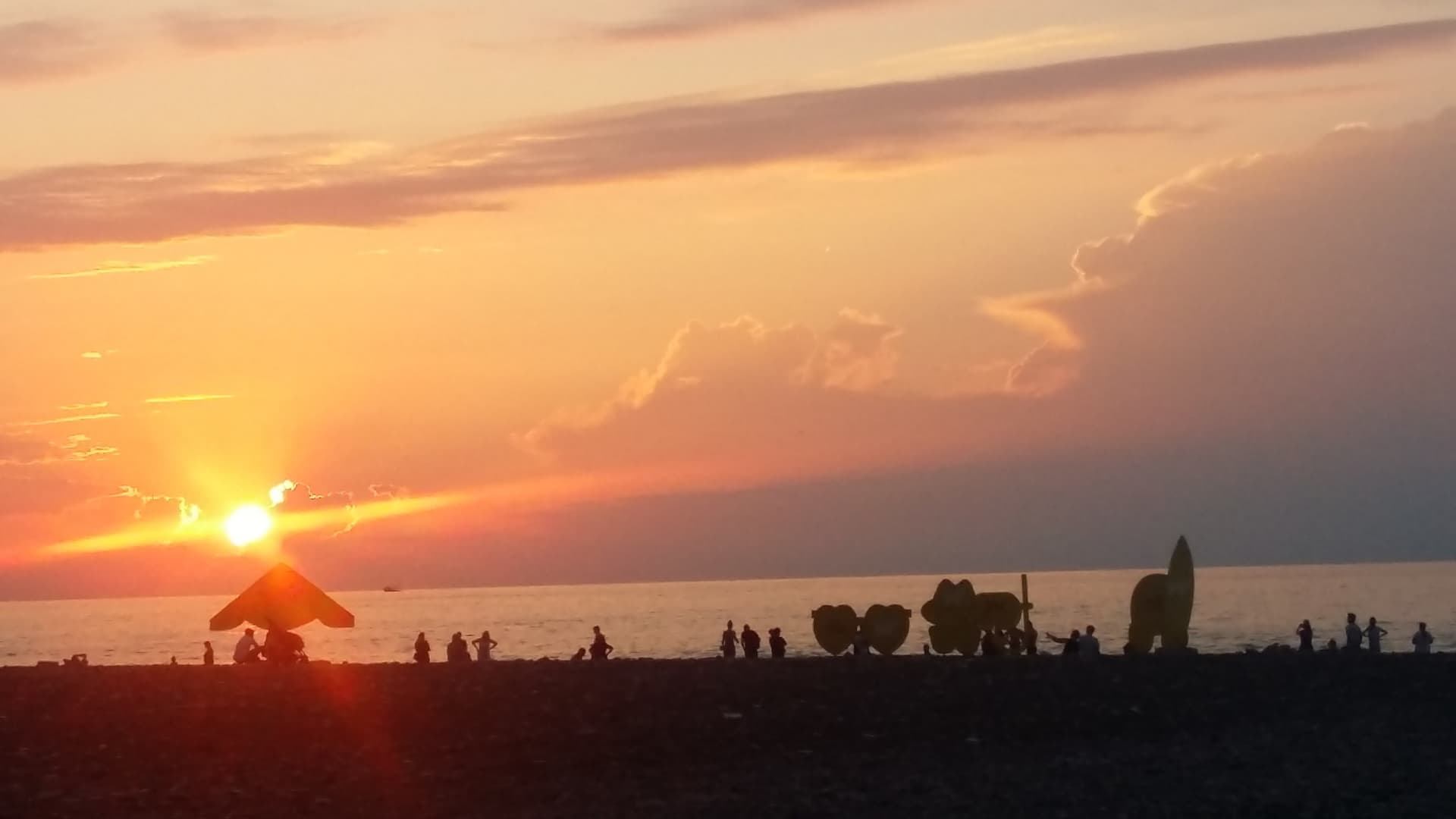
Want to perfect your tan? Batumi is filled with pebble beaches, notable for their magnificent patchwork of colors. This resort is also the ideal place to take a dip in the warm waters of the Black Sea or stroll along the palm-lined promenade.
Climate in Batumi
Batumi and its surroundings comprise one of the most important resort areas along the Black Sea coast. Thanks to its excellent coastal location and subtropical climate, Batumi offers the ideal setting for a wonderful vacation in the Caucasus. In Batumi, winters are mild and summers are warm. The average annual temperature is 14.5°C.
In January, the coldest month of the year, the average temperature is 7.1°C, whereas in August, the warmest month, it rises to 23.2°C. The city experiences significant precipitation, even during the driest month of the year. Annual rainfall reaches 2,560 mm. As for snow, it is rather rare. But when it does occur, it melts quickly. On the coast, the average annual sea temperature is 16.7°C.
By Air:
It is possible to reach Batumi by plane, as the city has an international airport. In fact, this is the fastest way to travel from Tbilisi to Batumi. The journey takes 2 hours 31 minutes.
By Bus:
If you prefer road routes, there are regular connections by minibus (marshrutka) and bus between Tbilisi and Batumi. The distance from Tbilisi to Batumi by road is 358.4 km.
The journey takes approximately 6 hours 30 minutes, including transfer time. A ticket costs 30.08 lari. Bus services depart 5 times daily and operate every day.
By Train:
There is a direct train from Tbilisi Central Station to Batumi. Train services depart twice daily and operate throughout the week. The journey takes approximately 5 hours. A ticket costs between 21 and 68 lari.
The city of Batumi has various transport options. It is notably equipped with 15 bus lines. A ticket costs 0.40 GEL. Taxis are another practical option for getting around town. They are available 24/7. Moreover, it is entirely possible to book a taxi in advance.
You can also opt for car rental. Rental agencies are generally located in the city center. And to move more easily along the riverbanks or simply stroll through town, nothing beats a bicycle, via the bike-sharing system or Batum Bike. Cycling paths line Batumi's coast as well as the streets of the old town.
Want to discover this destination?
Our local advisors design your tailor-made trip.