Kazbegi
Kazbegi
At the foot of Mount Kazbeg and the mythical Gergeti Church, Kazbegi is the base camp for lovers of the Georgian Greater Caucasus. Our complete guide.
Kazbegi or Stepantsminda, located in northern Georgia, is a village ideal for high-altitude mountain sports activities. Trekking enthusiasts and those seeking spectacular views—particularly of Mount Kazbeg—will find their visit to this part of the country truly rewarding.
This charming village also serves as an excellent base for exploring more of the Mtskheta-Mtianeti region.
A Journey Through Kazbegi's (Stepantsminda's) History
Stepantsminda is a Georgian village located in the Mtskheta-Mtianeti region, approximately 15 km from the Russian border.
Named after the 19th-century prince and poet Alexander Kazbegi from 1925 to 2006, it is the capital of the Kazbegi district.
Meaning Saint Stephen, its name references the first protomartyr of Christianity.
The village's name "Stepantsminda," which literally means "Saint Stephen," originates from the Georgian Orthodox monk Stephen who built a hermitage at the location that would later become the Georgian Military Road.
The arrival of the Russians on Georgian territory in 1801 sparked uprisings beginning in 1804. Unfortunately, due to the loyalty of Gabriel Chopikashvili, who would later be promoted to officer in the Russian army, the Georgians were unable to repel the Russian Empire from their kingdom.
Becoming the established leader, he gave the city the name of his father, "Kazbegi," in 1925. Only after 2006 did the city resume its original name, "Stepantsminda."
Kazbegi Today: A Haven of Greenery
Kazbegi, officially called Stepantsminda, is a mountain village traversed by the Georgian Military Road, which connected Tbilisi and Vladikavkaz in the 19th century.
It nestles in a verdant haven in the Northern Caucasus, at the foot of Mount Kazbeg, which peaks at 5,047 meters, one of the most majestic mountains in the region.
A stay here allows visitors to combine the warmth of local hospitality with a unique travel experience.
It is one of Georgia's most beautiful villages and a destination favored by nature enthusiasts.
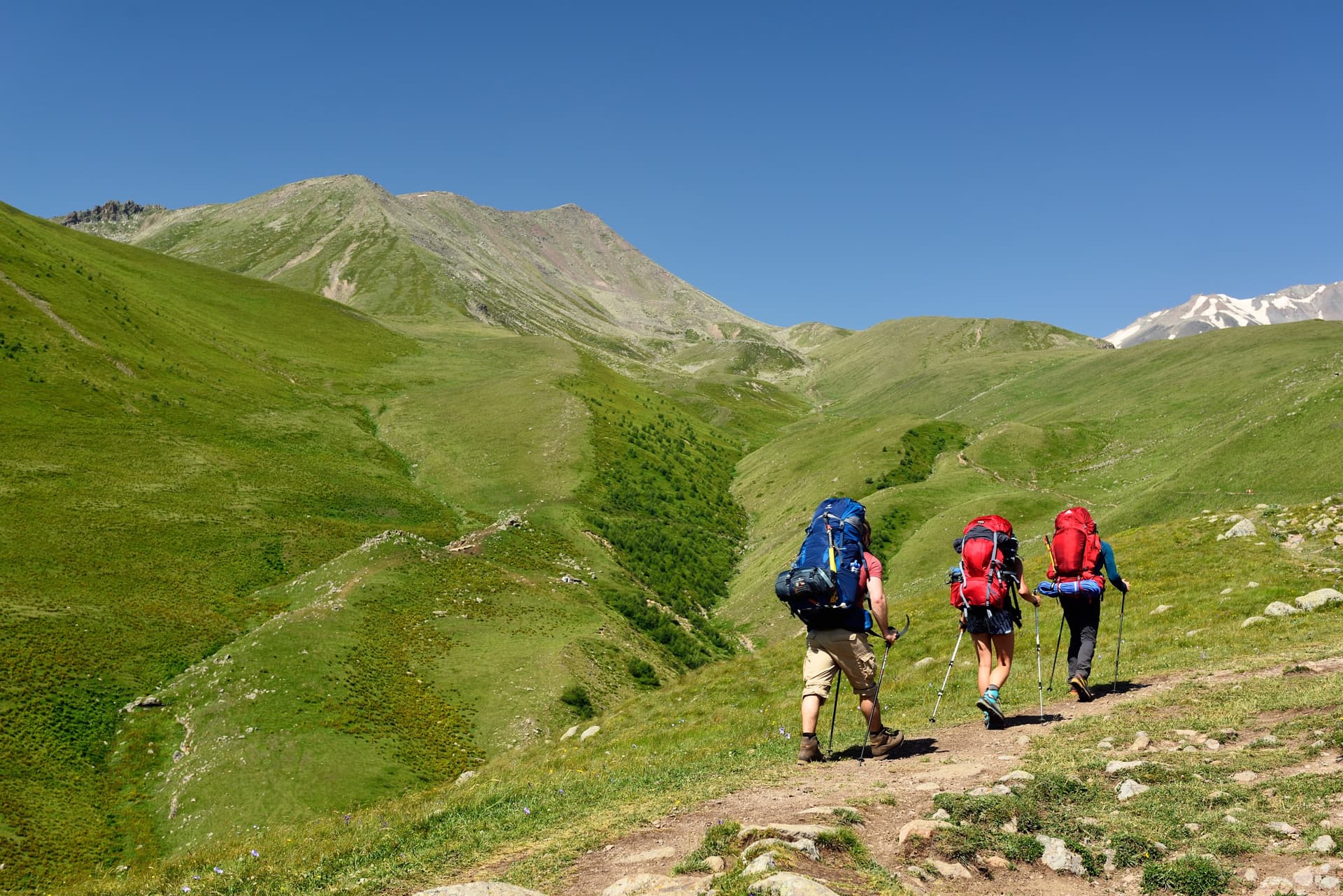
It captivates with its vast green spaces covered in coniferous forests and alpine meadows that line the lower slopes of mountains and magnificent glaciers. A tour through this mountain village also offers the chance to traverse the finest hiking trails, admire sheer waterfalls, and swim in crystalline waters while enjoying breathtaking views of the extinct volcano.
Here, nature leaves hikers dreaming, particularly of the majestic snow-capped mountains overlooking Kazbegi. With peaks ranging between 2,500 and 5,642 meters, these mountains are ideal for mountaineering and trekking.
One of the most beautiful peaks along the military road is undoubtedly the Cross Pass (Djvari).
Rising to an altitude of 2,379 meters, it geographically separates the Southern Caucasus from the Northern Caucasus.
Kazbegi: A Premier Tourist Destination
Gergeti Monastery, perched at 2,400 meters above sea level, is a must-see. Once you reach the summit of Mount Gergeti, the view is simply magnificent.
The village of Kazbegi is also an ideal location for thrill-seekers, who can attempt the ascent of Mount Kazbeg, Georgia's second-highest volcanic mountain.
Rising to 5,047 meters above sea level and located in the western part, it is ideal for trekking or mountaineering.
During their stay, travelers will have the opportunity to try tandem paragliding from Gudauri, the winter sports resort located on the southern slope of the Greater Caucasus.
A paragliding flight lasts on average 20 to 25 minutes and takes you to the summit of the ridges.
The view of Djvari Pass or the Aragvi Valley is breathtaking.
Beyond its location, approximately 100 kilometers from Tbilisi, Georgia's capital, Kazbegi is easily accessible by the most picturesque and modern road in the country.
An Unforgettable Escape in the Kazbegi Area
Covered with glaciers spanning 135 km², the Kazbegi area is perfect for ice climbing or mountaineering.
The Devdoraki Glacier, whose hiking trail begins in Stepantsminda, is particularly worth visiting.
Along the way, you'll discover the Dariali Gorges, the Gveleti Waterfall, a birch forest, and various plants typical of the alpine climate.
The trail continues through the Dariali Gorges, a steep crevasse in the mountains connecting Georgia to Russia. These gorges, stretching for 18 km, begin at the confluence of the Chkheri River (located near Stepantsminda) and end near Upper Lars (the Russian-Georgian border crossing).
They are distinctive for housing a Georgian Orthodox Church.
At certain points in the Dariali Gorges, the cliffs rise more than 1,000 meters high. The waterfalls, medieval watchtowers, and incredible wildlife make it one of Georgia's most beautiful natural sites.
On either side of the gorges, steep valleys unfold. These constitute excellent birdwatching spots. Among the rocky outcrops live falcons, vultures, and eagles.
After traversing the Dariali Gorges, head to the Gveleti Waterfall, located approximately 7 km from Stepantsminda. Gveleti, meaning "place of serpents" in Georgian, it is indeed crucial to carefully monitor local wildlife.
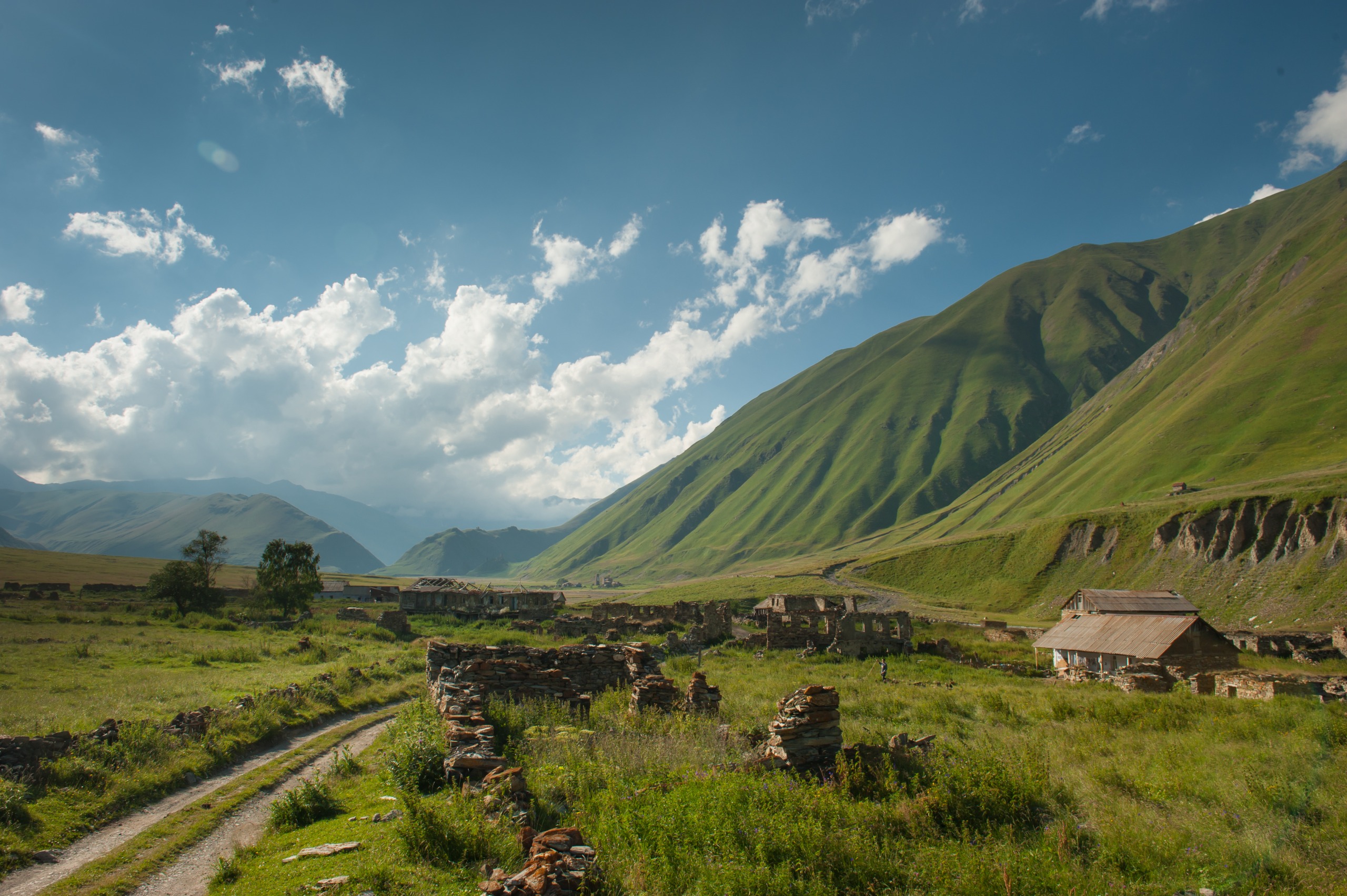
Upper Truso Gorge is another leading Georgian natural site, situated near Stepantsminda. These gorges contain several historical and cultural sites, including abandoned villages, glacial and fluvial deposits, birch forests, and the remains of colorful sediments from mineral waters.
Near the Russian border at Upper Lars lies Khada Gorge, a zone highly prized by mountaineers. To reach it, you must pass through the Dariali Gorges and a 17 km hiking trail, crossing a monastic complex.
The village of Sno, located approximately 5 km from Stepantsminda, is also worth a visit. It is the residence of the Patriarch of the Georgian Orthodox Church. In the courtyard of the residence stands a small church, a fortified tower dating from the 16th century, and a statue of Vakhtang Gorgasali.
The village of Juta, standing at 2,200 m, concludes this hiking route. It is located 24 km from Stepantsminda. The passage through Juta offers an opportunity to explore, via hiking, the Chaukhi Mountain Range, situated near the village.
What to Do During a Day Excursion to Kazbegi?
For a day excursion to Kazbegi and its surroundings, take the Georgian Military Road. Departure occurs early in the morning from Tbilisi.
Along the way, numerous sites are worth visiting, such as Ananuri Fortified Castle,
located on the Aragvi River. It is a complex of castles dating from the 16th century.
The fortress is protected by tall stone walls with turrets. Within these walls stand two churches, a reservoir, and a watchtower.
The chapel's main façade features magnificent floral and animal motifs in the Celtic style.
The next stop along the route is Gudauri, a remarkable ski resort standing at 2,200 meters. This resort offers skiing opportunities from December to April.
From Gudauri, head toward the Trinity Church of Gergeti. Perched at an altitude of 2,170 meters, constructed in the 14th century on the southern slopes of Mkinvarcveri, this basilica is a unique monument due to its location.
It stands below the white massif of Mount Kazbeg. This church is also remarkable for the cross of Saint Nino housed within and its magnificent dome. It is the only church to possess one throughout northern Georgia. During Russian occupation, it was the only one to host religious ceremonies.
Alexander Kazbegi Historical Museum (1848–1890) is another monument well worth seeing. It houses the personal belongings of the famous writer, an extensive library, ethnographic artifacts from the Khevi region, archaeological objects, religious relics, and a gallery dedicated to craftsmanship.
By Marshrutka:
Marshrutkas (shared minibuses) are one of the most popular means of transport to reach Kazbegi, due to the affordable ticket price of 10 GEL (one-way).
They depart approximately every hour from the Didube Bus Station in Tbilisi, several times daily.
The journey takes 2 hours 45 minutes, with approximately a 15-minute break halfway.
Generally, for a group of 8 passengers, the stop is at Ananuri Church of the Mother of God.
For a group of 15 people, the stop is scheduled at the Russia-Georgia Friendship Monument.
By Taxi:
Those preferring not to travel with others can opt for private taxis connecting Tbilisi to Stepantsminda. The fare is approximately 150–200 GEL.
Moreover, several taxis also offer round trips to the Trinity Church of Gergeti for 40 GEL, departing from Kazbegi.
Taxis in Kazbegi are easy to identify by a white sign placed on the dashboard. It generally contains the name of the city and the number to contact to arrange a route.
Car Rental:
Another option for reaching Kazbegi is to rent a car. The driver will need to take the Georgian Military Road, which can be quite winding and steep. You will also pass through narrow gorges threading through mountains.
Furthermore, Kazbegi is a small town and getting around is easily done on foot.
What Is the Climate Like in Kazbegi?
In Stepantsminda or Kazbegi, the climate is rather temperate cold. Precipitation is significant, even during the driest month of the year.
The average temperature is 3.9°C, with average annual precipitation of 1,043 mm.
Between the driest and wettest months, a difference of 115 mm can be recorded.
July remains the warmest month of the year, with an average temperature reaching 13.9°C.
January is the coldest month of the year. The average temperature stands at −6.5°C.
Want to discover this destination?
Our local advisors design your tailor-made trip.