Uplistsikhe
Uplistsikhe
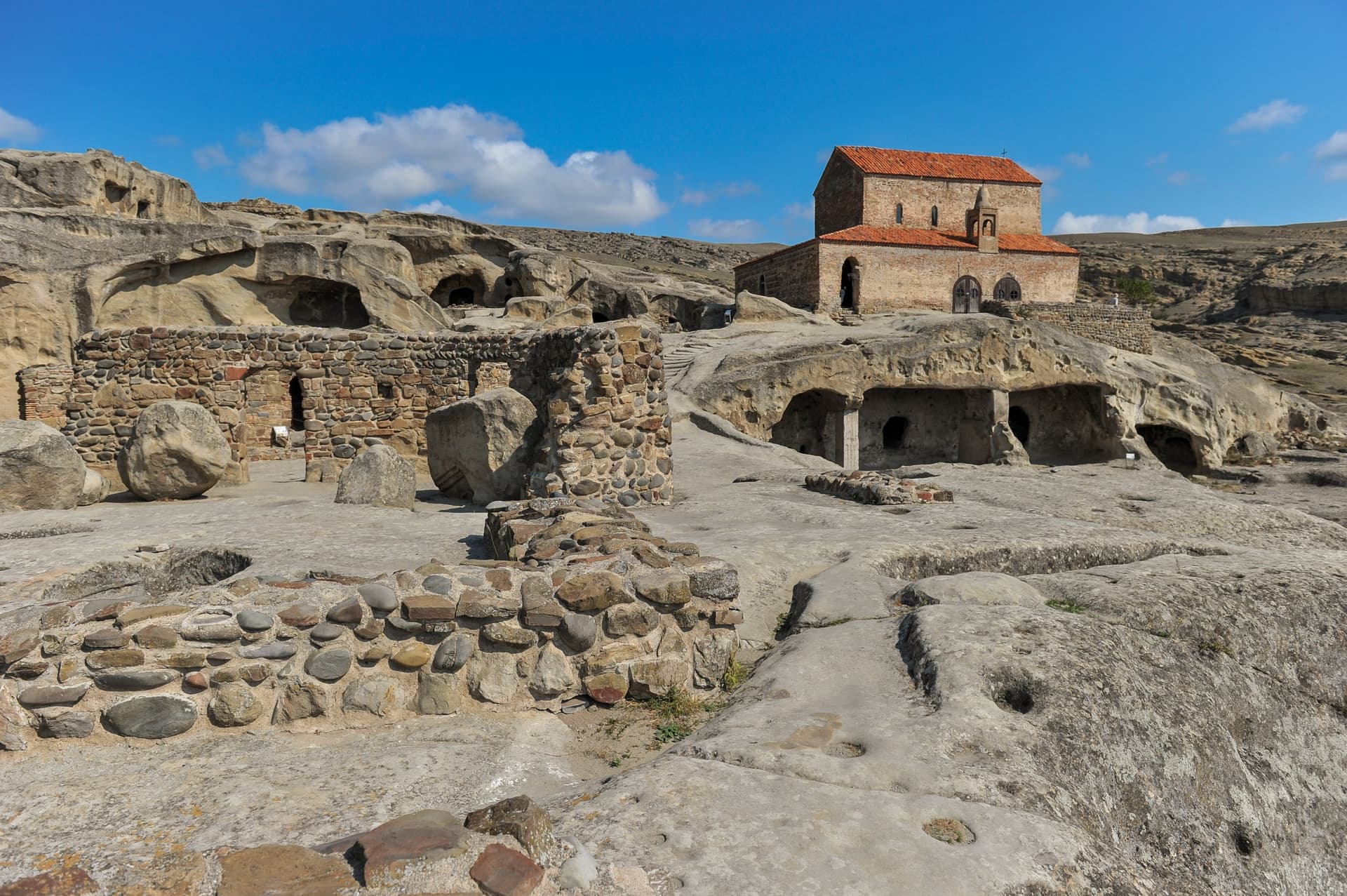
Georgia's oldest cave city, Uplistsikhe preserves 150 caves carved into sandstone, about ten kilometers from Gori.
A troglodytic settlement carved into rock about ten kilometers east of Gori, Uplistsikhe, whose name means "the fortress of God," ranks among the Caucasus's oldest settlements. Of the 700 caves the site once contained at its peak, approximately 150 remain today, spread across roughly 8 hectares overlooking the Mtkvari River.
Why visit Uplistsikhe
The site condenses nearly three millennia of Georgian history within a rock-cut complex unique in its kind. It is the oldest of Georgia's three major troglodytic cities, alongside Vardzia and David Gareja, and among the few to preserve civil, religious, and defensive structures entirely carved from sandstone. The site has been on the UNESCO World Heritage list since 2007.
- A direct witness to Georgia's transition from pagan cults to Christianization
- A strategic waypoint on the Silk Road for over a millennium
- A rare architectural ensemble: ancient theater, royal hall, medieval church, prison, pharmacy
- An open panorama over the Mtkvari valley and the foothills of the Greater Caucasus
History of Uplistsikhe
Archaeologists date the site's foundation to the late Bronze Age, at the beginning of the first millennium BCE. Human occupation continued there without major interruption until the thirteenth century. At its height, the city housed approximately 20,000 inhabitants distributed across more than 700 caves, making it one of the most densely populated urban centers of the ancient Caucasus.
From pagan center to Christian fortress
Before Christianity arrived, Uplistsikhe served as a regional pagan worship center. With the Christianization of the Kartli region in the early fourth century, the site lost its religious role to Mtskheta and then to Tbilisi. During the Muslim occupation of Tbilisi in the eighth and ninth centuries, Uplistsikhe became Christian Georgia's principal fortress. The reconquest of Tbilisi by David IV the Builder at the turn of the twelfth century shifted the kingdom's center of gravity and marked the beginning of the site's decline.
From decline to rediscovery
Mongol invasions in the fourteenth century ended the city's prominence. The site was subsequently used as an occasional refuge and secondary residence through the early twentieth century. An earthquake in 1920 destroyed the most fragile areas. Artifacts unearthed during excavations—silver, gold, and bronze jewelry, sculptures, ceramics—are preserved in Tbilisi's National Museum.
What to see on the site
The complex divides into three sectors: lower (south), middle (center), and upper (north). Four gates control access, complemented by hidden tunnels leading directly to the Mtkvari River. The middle section, the largest, concentrates most of the monumental structures.
Civil and ceremonial structures
- Queen Tamar's royal hall, with its two ancient columns, intended for official ceremonies
- The chamber called Queen Tamar's room, adorned with lateral niches
- The ancient theater dating from the second to third centuries, considered Georgia's first theater, with its octagonal ceiling and central stage
- The prison, identifiable by its wells dug to depths of 80 meters
- The pharmacy, where medicinal herbs were found during excavations
Rock-cut architecture
Most caves present sober decoration, though some large halls retain vaulted coffered ceilings carved directly into sandstone. Atop the complex stands a Christian church built of brick and stone in the ninth to tenth centuries, replacing an earlier pagan sanctuary. Narrow streets, staircases, and galleries connect the different levels.
Practical information
Site entry is fee-based but remains moderately priced. Allow 1.5 to 2.5 hours for a visit depending on your interest in archaeology. The terrain is uneven, with steps and low passages: wear closed shoes with good grip. In summer, the lack of shade makes water, a hat, and sunscreen essential.
When to visit
The climate is humid continental with no distinct dry season. July is the warmest month, averaging around 22°C, while January averages below zero (-0.3°C). The most comfortable period extends from May through October, with a preference for late spring and early autumn, when temperatures remain pleasant and the light shows off the ochre sandstone to advantage. Avoid the heart of winter, when rocky surfaces can be slippery.
How to get there
The logical starting point is Gori, about ten kilometers west of the site.
- From Tbilisi: minibuses depart from Didube station heading toward Gori. The journey takes roughly 1.5 hours. A train also connects Tbilisi to Gori in about an hour.
- From Gori: direct taxi to the site (quickest option, negotiable and shareable with others), or local bus to Kvakhvreli village, followed by a 2 km walk to the entrance.
- Organized excursion: most agencies in Tbilisi combine Uplistsikhe with Gori and Mtskheta on a day trip.
What to see nearby
- Gori, Stalin's birthplace and natural gateway to the site
- Dmanissi archaeological site, another major Georgian archaeology landmark southwest of Tbilisi
- Gelati Monastery, UNESCO-listed medieval complex
- Tbilisi Open-Air Ethnographic Museum, a useful complement to contextualize the site within its cultural setting
Frequently asked questions
Frequently asked questions
Plan between 1.5 and 2.5 hours on site to explore the three sectors and climb to the church at the complex's summit.
Yes, but visiting comfort varies significantly with the season. Spring and autumn offer the best conditions; winter can make rocky passages slippery.
Yes, the site is freely accessible. A local guide or organized tour from Tbilisi does, however, provide useful insights into the history and function of the various structures.
The site has been in the UNESCO recognition process since 2007 and is regularly cited as one of the Caucasus's major archaeological complexes.
Yes. The classic combination includes Gori, Mtskheta, and Uplistsikhe on a day trip from Tbilisi.
Plan your trip
Uplistsikhe fits naturally into an itinerary connecting Tbilisi, Mtskheta, and the Kartli region. To build a customized trip including this site, explore our Georgia trips.
Interested in this visit?
We can include it in your personalised itinerary.