Vardzia Troglodytic City
Vardzia Troglodytic City
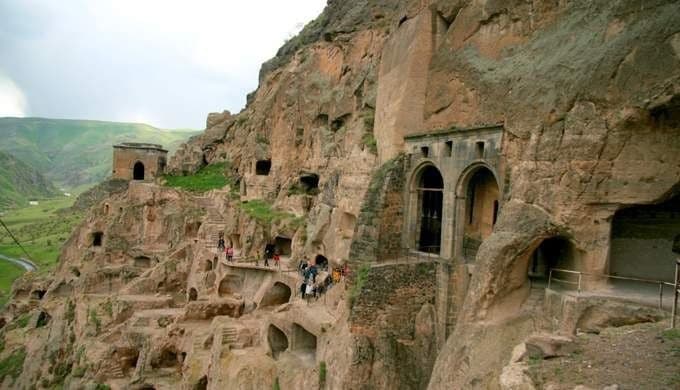
A monastic complex hand-carved into a cliff in southern Géorgie during the 12th century, Vardzia unfolds 3,000 caves across 19 levels and bears the imprint of Queen Tamar's legacy.
Vardzia is a Georgian troglodytic monastic complex entirely shaped from rock and carved entirely by hand. The journey is all the more captivating as the fortress is built overlooking a picturesque valley.
Guided exploration of this underground city perched on Mount Erusheti.
Vardzia, a Remarkable Troglodytic "City" to Discover
Géorgie is home to one of Europe's most impressive historical and cultural sites: Vardzia Cave Citadel. Its defining characteristic is that it has been carved entirely into the rocky slopes of Mount Erusheti.
This underground fortress is located precisely on the left bank of the Mtkvari River, roughly thirty kilometers from the town of Aspindza.
Based on excavations conducted during the Soviet era, it was proven that this troglodytic "city" has been inhabited since the Bronze Age.
Originally, it was constructed as a military base and fortress against attacks by Turkish troops. Later, it served as a religious site.
According to legend, the origin of the name Vardzia is closely linked to King George III and his daughter, the future Queen Tamar.
When she was young, the queen accompanied the King and his nobles on a hunting expedition near the caves. Unfortunately, she became lost in the caverns.
Everyone began searching and calling for her. Hearing their calls, she responded "ar var, dzia" meaning "I am here, uncle"—"uncle" being a common term used by Georgian children to say sir. The combination of these words gave the site its name: "Vardzia".
During Tamar's reign, Vardzia reached its zenith. Historians notably reference the queen's significant contributions to the economic development of the citadel, not to mention the magnificent residences carved into natural caves.
The Vardzia Fortress, a Unique Structure
48 years of labor were necessary to hand-carve the Vardzia troglodytic complex.
The natural caves stretch 500 meters along the cliff face. The site, spanning 19 levels, contained more than 3,000 caves and could accommodate up to 50,000 inhabitants.
These were connected to one another by an intricate system of secret passages. In fact, these hidden tunnels were the only way to access this underground city.
King George III began construction of the fortress in the 12th century, and Queen Tamar decided to continue and complete the troglodytic complex after his death.
Originally, the citadel comprised 3,000 residential spaces. Approximately 600 residential units, reaching 900 meters in altitude, were built within the steep tuff walls on the left bank of the Koura River.
According to legend, 366 apartments—one for each day of the year—belonged to Queen Tamar, intended to prevent her enemies from finding her. Each residence consisted of three adjacent rooms.
Beyond residential spaces, this underground sanctuary also contained a throne room, stables, barracks, temples, baths, libraries, shops, a kitchen with dining hall, wine presses, and an extensive water distribution network.
The fine wine cellars are also renowned features of this citadel. There were 28 in total, including 6 among the 300 church-halls and 22 in the storage areas.
At the center of the fortress stands the Church of the Dormition, also known as the Grand Temple of the Virgin Mary.
At the church entrance rises a columned portal, adorned with 2 arches. Several murals decorate the interior, depicting major historical scenes from the life of Christ and Georgian royalty. The paintings are all the more exceptional as they were created using traditional local techniques.
On the floor, note the terra cotta water conduits dating from the 13th century.
Water supply for this entire underground city was managed through a 3.5 km-long tunnel.
Near the bell tower of the Church of the Dormition are the remains of pipes that channeled 160,000 liters of water produced daily.
Food, which was kept warm in summer and cool in winter, was stored at the rear of the caves.
More than 100 monks lived permanently in this monastic complex, and thousands of individuals were able to take refuge here during attacks.
Today, it is possible to find some monks who can serve as guides through the Vardzia fortress.
The distance from Tbilisi to Vardzia is 260.3 km. By road, the journey takes approximately 3 hours 30 minutes.
Taxi is the fastest way to travel from Tbilisi to Vardzia. The journey takes 3 hours 27 minutes.
By bus, there is no direct line from Tbilisi to Vardzia. However, from Tbilisi-Didube station, it is possible to reach Vardzia via Akhaltsikhe. The journey, including connections, takes approximately 6 hours.
Climate in Vardzia
At Vardzia, summers are pleasant, with generally clear skies.
If you are planning a stop in Vardzia during a Géorgie discovery trip, the ideal time is during summer, from late June through early September.
Winters are rather cold and partly cloudy, and you should expect abundant snowfall.
Throughout the year, temperatures range from −10°C to 26°C, though they can exceptionally drop to −16°C and rise to 31°C.
Want to discover this destination?
Our local advisors design your tailor-made trip.