Bordjomi and Central Georgia
A thermal valley at 850 meters altitude, an 85,000-hectare national park, and the cave monastery of Vardzia, carved into cliff face in the 12th century.
The region we call Central Georgia stretches from the Koura valley to the foothills of the Lesser Caucasus, along a Tbilissi-Akhaltsikhé axis that forms the backbone of the country's south. Our team considers it a pivotal waypoint between the capital and the Black Sea coast, but also a territory that deserves three to four days in its own right. Within hours you travel from agricultural plains at 700 meters elevation to beech and fir forests of the Lesser Caucasus, which rise above 2,800 meters in the Mtirala massif.
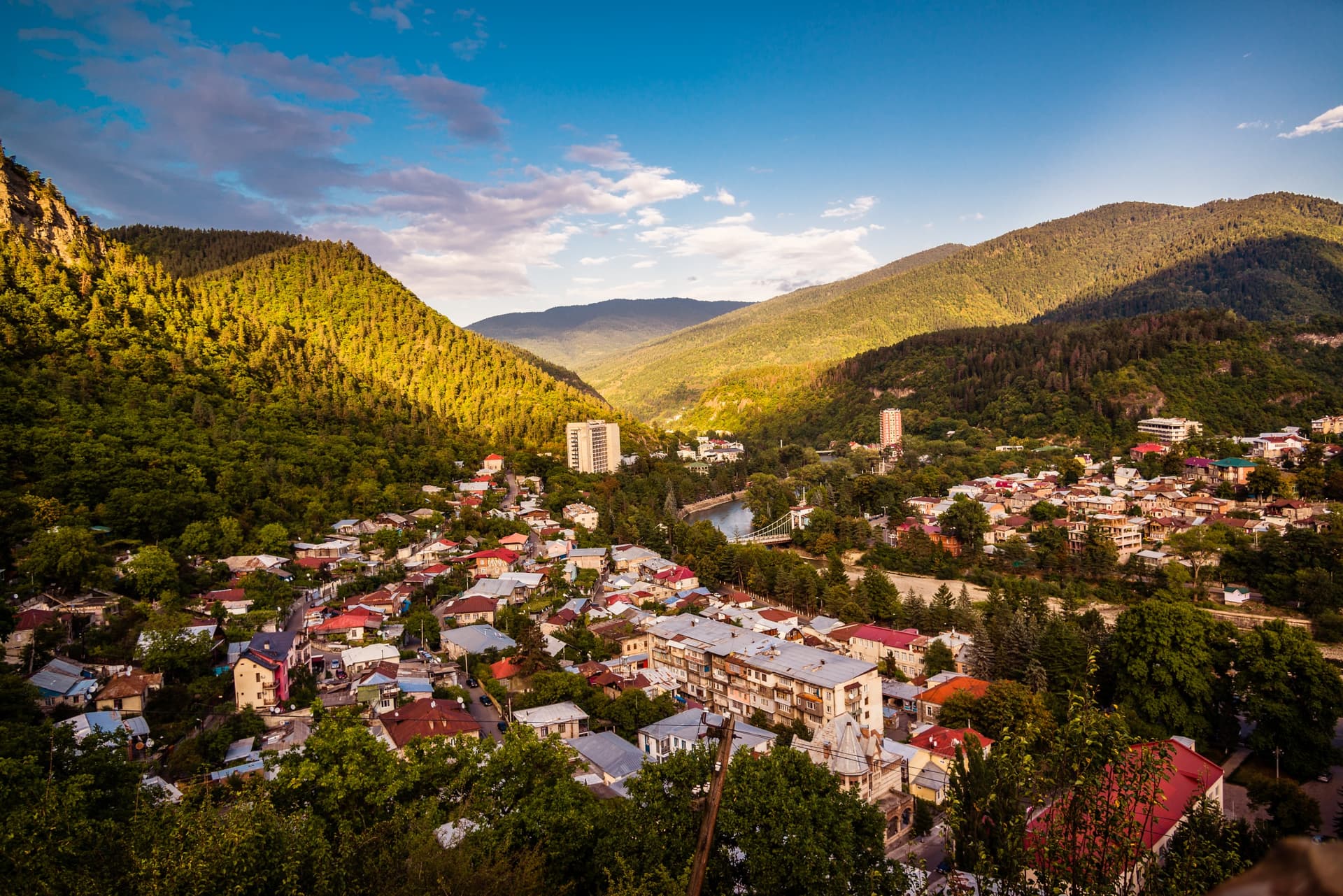
Bordjomi, at 850 meters altitude, owes its reputation to mineral springs captured as early as 1829 by Russian troops stationed in the region, then bottled on a large scale from the 1890s onward under the patronage of Grand Duke Mikhail Romanov. The water, salty and naturally carbonated, flows at 38 degrees Celsius in Ekaterina Park, at the heart of the city. The Borjomi brand remains one of Georgia's best-known export products, and the old carved wooden dachas of tsarist dignitaries still bear witness to that thermal epoch.
Above the city lies Bordjomi-Kharagauli National Park, created in 1995 with WWF support. Its 85,000 hectares make it one of the Caucasus's largest protected areas. We send travelers here who want to hike for one to three days on marked trails, staying in simple mountain refuges (Lomis Mta, Sametskhvario). You'll encounter shepherds with their summer herds, sometimes deer, and in the most remote valleys, traces of brown bears. The hiking season runs from mid-May through late October, with high-altitude trails remaining snow-covered until June.
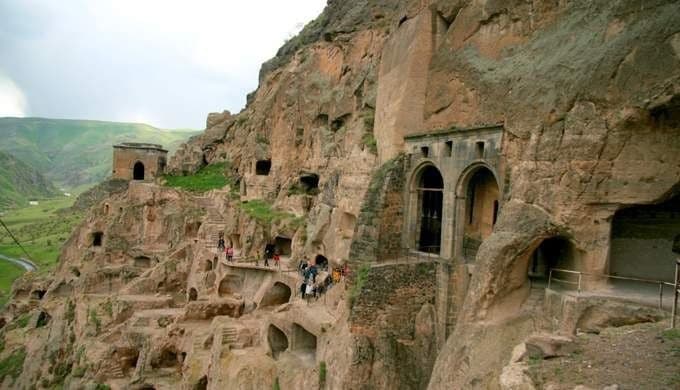
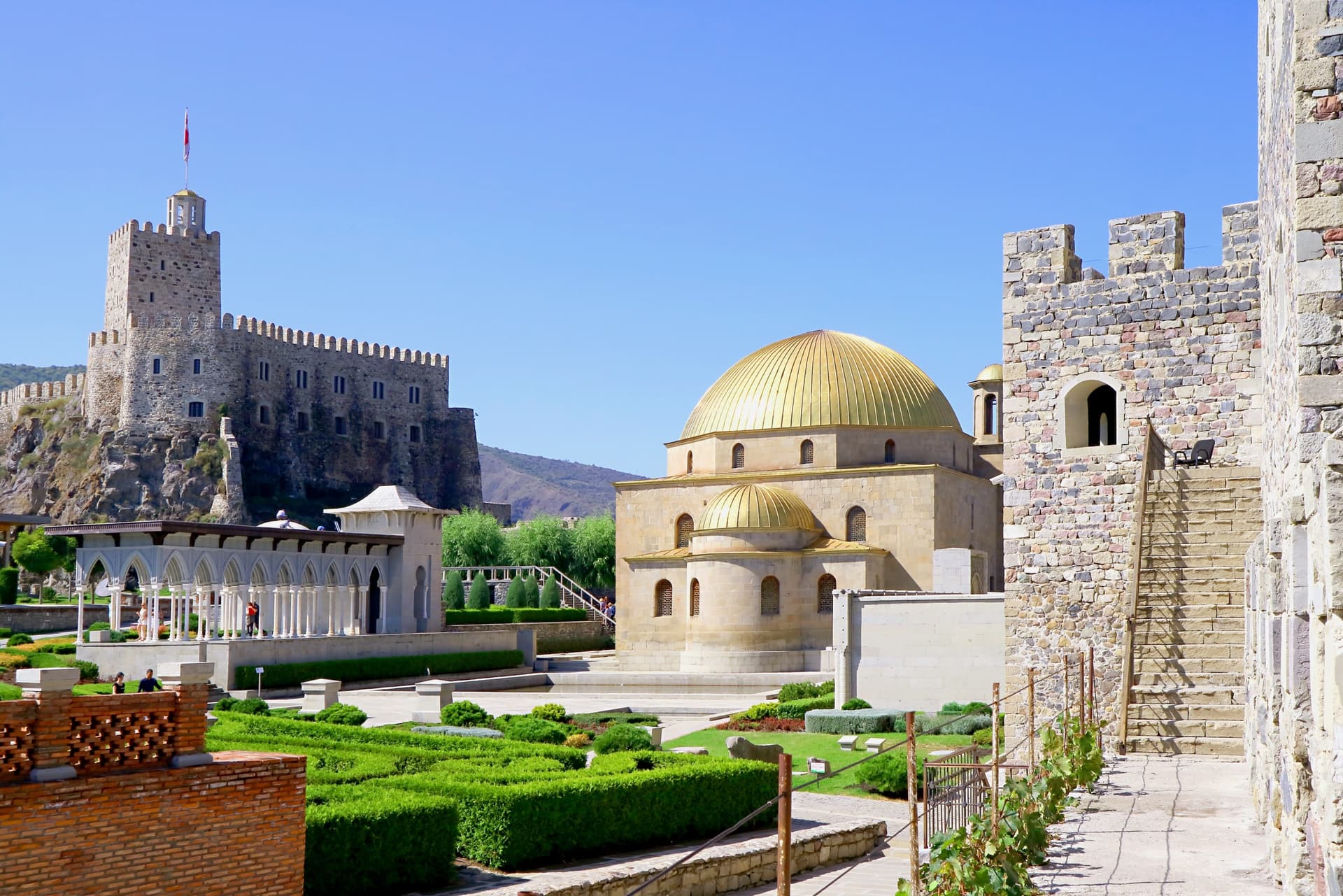
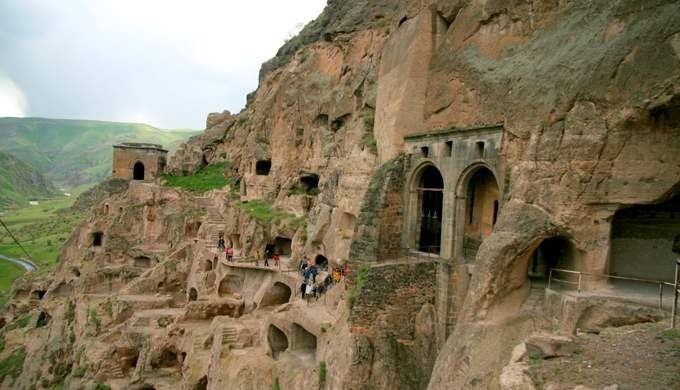
Further southwest, the road climbs the Koura valley to Akhaltsikhé, once the capital of the Samtskhé principality under Ottoman rule from the 16th to 19th centuries. Rabati Castle, restored between 2011 and 2012, blends within its walls an Orthodox church, a domed Ottoman mosque, and a madrasa—a reflection of the mixed population that inhabited the city before 20th-century forced displacements. Some 60 kilometers away, the cave monastery of Vardzia, carved under Queen Tamar between 1185 and 1203, once contained up to 3,000 grottos spread across 13 levels before an earthquake in 1283 tore open the cliff face. Some frescoes in the Church of the Dormition remain visible today, and about a dozen monks still live there.
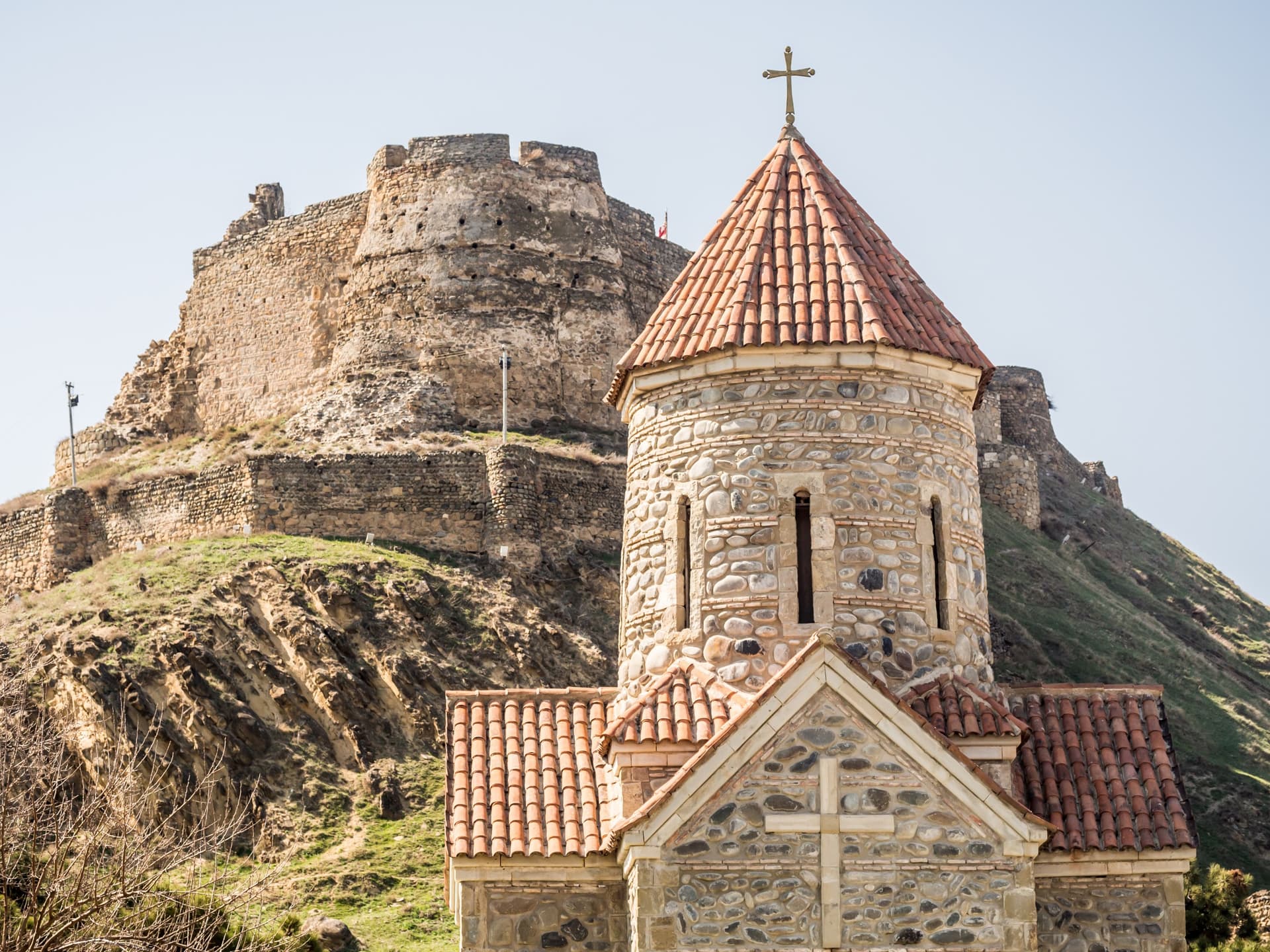
The region also includes two stops we often recommend en route from Tbilissi: Gori, Stalin's birthplace with its controversial museum, and the cave-city of Uplistsikhe, a rock-hewn settlement inhabited from the 1st millennium BCE until the 13th century. Further north, Mtskheta, the former capital and seat of the Georgian Orthodox Patriarchate, preserves Svetitskhoveli Cathedral (11th century) and Jvari Monastery, perched on a promontory above the confluence of the Aragvi and Koura rivers. Both of these sites are UNESCO World Heritage–listed.
The cuisine here differs noticeably from wine-producing Kakheti. Closer to the Turkish border, there is more mutton-based fare, khinkali (boiled dumplings) filled with mountain herbs, and the local khachapuri, denser than its Ajarian variant. The Koura valley orchards yield plums, cornelian cherries, and apples that locals transform into tklapi, thin sheets of fruit dried in the sun, found again in tkemali sauce.
To discover
Vardzia cave monastery. Thirteen levels of grottos carved into the tuff cliff in the 12th century above the Koura, with Queen Tamar's frescoes still visible in the Church of the Dormition. Plan for two hours of exploration, ideally in late afternoon when light rakes the rock face.
Hiking in Bordjomi-Kharagauli National Park. Trails ranging from 1 to 6 days through 85,000 hectares of mixed forest, wooden refuges, thermal springs along the Saint Andrew trail. Accessible from mid-May through late October.
Rabati Castle in Akhaltsikhé. A 13th-century fortress now restored, where an Orthodox church, Ottoman mosque, and madrasa coexist within the same walls. A testament to three centuries of Ottoman presence in southern Georgia.
Bordjomi mineral springs. Drinking pavilion in Ekaterina Park where you taste the sulfate water at 38 degrees Celsius free of charge, followed by a ride on a Soviet-era cable car up to the forested plateau overlooking the city.
Uplistsikhe, pre-Christian cave city. Ensemble of halls, theaters, and pharmacies carved into sandstone from the 1st millennium BCE onward, occupied until the Mongol invasion. A natural waypoint between Tbilissi and Bordjomi.
When to visit
We recommend this region from mid-May through mid-October. May and June offer the greenest landscapes, with daytime temperatures between 18 and 24 degrees Celsius in Bordjomi and cool nights around 10 degrees. July and August remain pleasant thanks to the altitude (rarely above 28 degrees in Bordjomi, versus 35 in Tbilissi), which historically made it a summer retreat. September is our favorite month: stable skies, forests turning color, crowds thinned.
From November through March, snow blocks parts of the national park's trails and access to Vardzia is sometimes over icy roads. Temperatures regularly drop below freezing in Bordjomi, around minus 5 to minus 10 degrees Celsius in January. The region remains visitable in winter for its thermal waters and the small Bakouriani ski station (1,700 m), but high-altitude hikes are closed.
Practical advice
We recommend three to four full days for the region, leaving Tbilissi by car (180 km, 3 hours to Bordjomi via the motorway then the national road following the Koura). A typical itinerary involves one night in Mtskheta or Gori en route, two nights in Bordjomi for the national park and springs, and one night in Akhaltsikhé to combine Rabati and Vardzia. Roads are asphalt as far as Vardzia, rougher in the park's interior valleys.
The region pairs logically with Tbilissi and surroundings early in your stay, then extends either toward the Black Sea coast and Adjaria via the Khoulo road (250 km, a full day), or loops back toward wine-producing Kakheti. Lodging ranges from restored hotels in Bordjomi's old dachas to family guesthouses in Akhaltsikhé, unpretentious but with genuine hospitality. The region suits contemplative travelers, medieval history enthusiasts, and moderate-level hikers—less so for families with very young children due to distances.