Kazbegui and Central Caucasus
Three hours north of Tbilisi, the town of Stepantsminda at 1,750 metres opens onto Mount Kazbek, the pastoral valleys of Truso and Juta, and Khevsur culture.
Georgia's Central Caucasus unfolds across some hundred kilometres on either side of the Georgian Military Road, the historic axis linking Tbilisi to Vladikavkaz via the Jvari Pass at 2,379 metres. This administrative region of Mtskheta-Mtianeti covers the districts of Kazbegui and Dusheti—just under 7,000 square kilometres of high valleys, alpine plateaus and jagged ridges forming the country's northern border with Russia.
Stepantsminda, formerly Kazbegui during the Soviet era, serves as an anchor point at 1,750 metres. The town has roughly 1,300 inhabitants, a modest market, a handful of family-run guesthouses and butchers processing livestock at the village edge. The view from the central square opens directly onto Mount Kazbek, an extinct stratovolcano at 5,054 metres whose snow-capped summit dominates the entire Terek valley. The river originates just a few kilometres south, cuts through the village and flows northward toward the Ossetian plain.
Khevsur culture, unique to the inhabitants of Khevi valley, long flourished in near-total self-sufficiency. Shepherds, horse breeders, keepers of mountain passes—the Khevsurs maintained until the early twentieth century a customary system of village councils that resolved disputes at the foot of the Church of the Holy Trinity at Guergueti. This fourteenth-century church, perched on a spur at 2,170 metres facing Mount Kazbek, also served as a refuge for the relics of Mtskheta during invasions. Today it is reached on foot in 1.5 hours via a steep trail, by 4x4 along a rocky track, or on horseback with shepherds from the village of Guergueti.
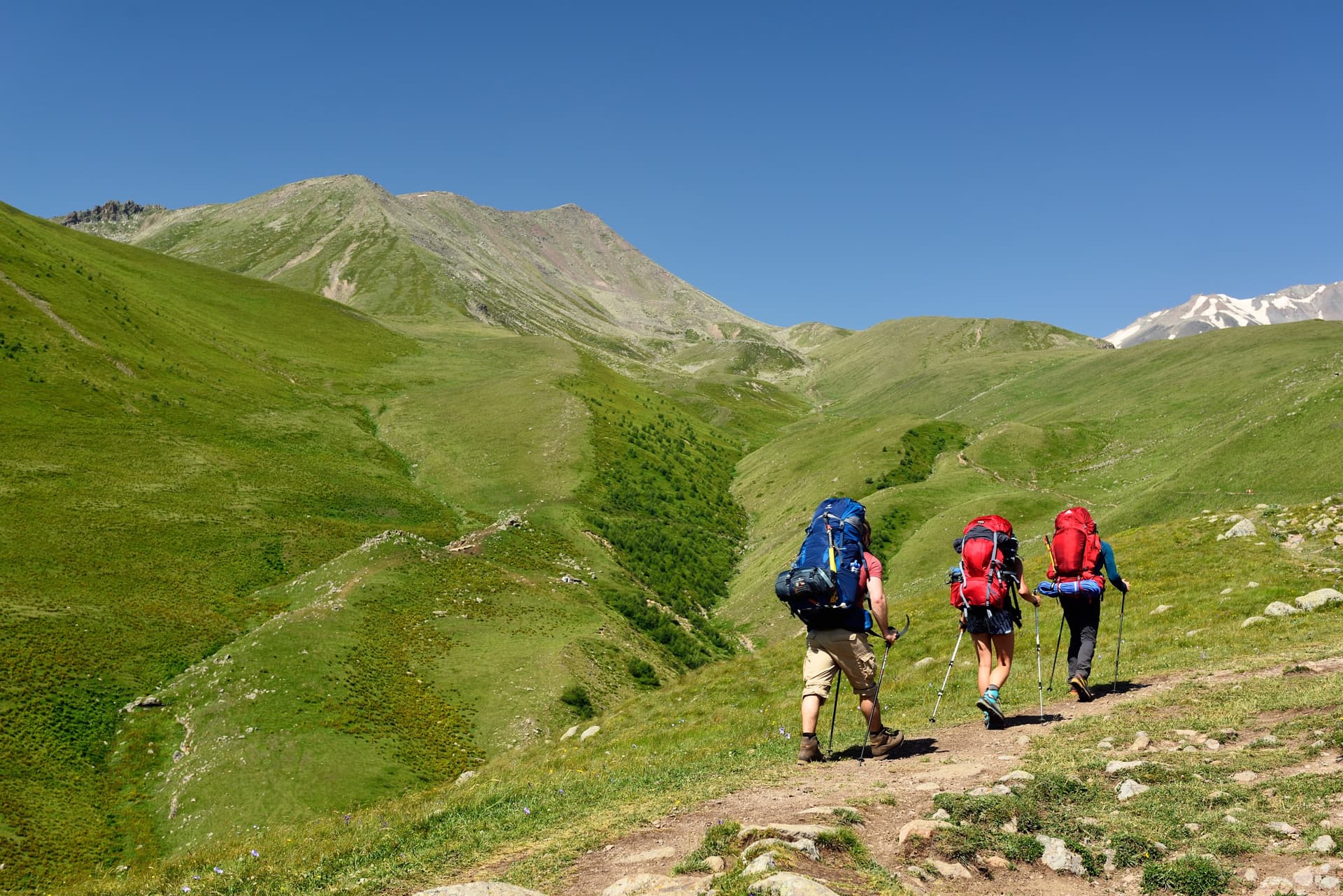
Lateral valleys structure the rest of the regional experience. Truso extends westward from Kobi along the upper Terek for roughly twenty kilometres, dotted with ferruginous springs whose ochre deposits line the banks, stone towers dating from the sixteenth and seventeenth centuries, and semi-abandoned hamlets like Ketrisi and Abano. The Sno valley, south of Stepantsminda, leads in 14 kilometres to the village of Juta perched at 2,200 metres, the classic starting point for hikes toward Chaukhi, a granite wall peaking at 3,842 metres. The Pchavi-Khevsurethi valley, further east, opens onto Khevsuretian lands, another mountain culture whose men wore chain mail well into the nineteenth century.
The economy remains pastoral and seasonal. Flocks of sheep and cattle move to alpine pastures between May and October, returning to lower elevations for winter. Ewe's milk cheese is produced in high-altitude hamlets, lamb khinkali in guesthouses, and a flat bread called mchadi baked on wood stoves. The Military Road carries trucks of goods daily toward Russia: it is the only year-round highway crossing between the two countries, and it substantially shapes the local economy.
This region thus concentrates, within a forty-kilometre radius of Stepantsminda, a rare array of alpine landscapes, vernacular architecture and still-thriving pastoral cultures. It is also the northern gateway to the country for travellers seeking to understand how Georgia bridges the Caucasus and the plains.
To discover
The Church of the Holy Trinity at Guergueti. A fourteenth-century sanctuary at 2,170 metres, reached in 1.5 hours of walking from Stepantsminda. Mount Kazbek rises directly ahead, the Terek winds 400 metres below.
Truso valley and its ferruginous springs. A day's walk along the upper Terek, between seventeenth-century stone towers and ochre deposits where carbonated water bubbles from the ground.
Juta and the Chaukhi cirque. From the hamlet of Juta at 2,200 metres, a 3 to 4-hour climb to the foot of the Chaukhi granite wall, where shepherds set up camp in July and August.
The Georgian Military Road. 170 kilometres from Tbilisi, with stops at Jvari Monastery, the Ananuri fortress on Lake Jinvali, and the Cross Pass at 2,379 metres.
A night with a local family in Sno or Guergueti. Lamb khinkali, fresh ewe's milk cheese, plum brandy served by the ladle. Family-run guesthouses remain the dominant form of accommodation.
When to visit
The favourable season runs from mid-June to mid-September. Daytime temperatures in Stepantsminda range between 15 and 22 degrees Celsius in July, dropping to 8 or 10 degrees at night, and trails above 2,500 metres clear of residual snow by mid-June. July and August also bring afternoon thunderstorms: start hikes early and descend before 3 p.m. May and October remain practical for those accepting cooler temperatures of 5 to 12 degrees and sometimes muddy trails.
From December to March, the Military Road closes regularly after snowfall, sometimes for several days at the Gudauri-Kobi pass. Stepantsminda remains accessible but lateral valleys like Truso and Juta become impassable by vehicle. This is a season reserved for skiers targeting the Gudauri resort at 2,200 metres, 35 kilometres south of Stepantsminda, open December through April.
Practical advice
We recommend a minimum of 3 nights on site to do the region justice: one travel day from Tbilisi with stops at Ananouri and the pass, one day for Guergueti church and the immediate Stepantsminda area, one full day in Truso or Juta. With 4 or 5 nights, you combine both lateral valleys and add a more challenging hike toward Chaukhi or the edges of Gergeti glacier. Access is by road from Tbilisi only—allow 3 hours without stops, 5 to 6 hours with visits.
The most coherent itinerary pairs Kazbegui with Tbilisi and surroundings at the start, then Kakheti for the contrast of vineyards to the east, or Borjomi and central Géorgie heading south. Travellers aiming for Svaneti should budget a full day's transfer—the two regions do not connect directly over the mountains. Accommodation remains at the family guesthouse level or a few upper-category hotels in Stepantsminda and Gudauri. The region suits hikers, contemplatives and families with children from 8 or 9 years old, provided you accept cool evenings and the rustic character of valley accommodations.