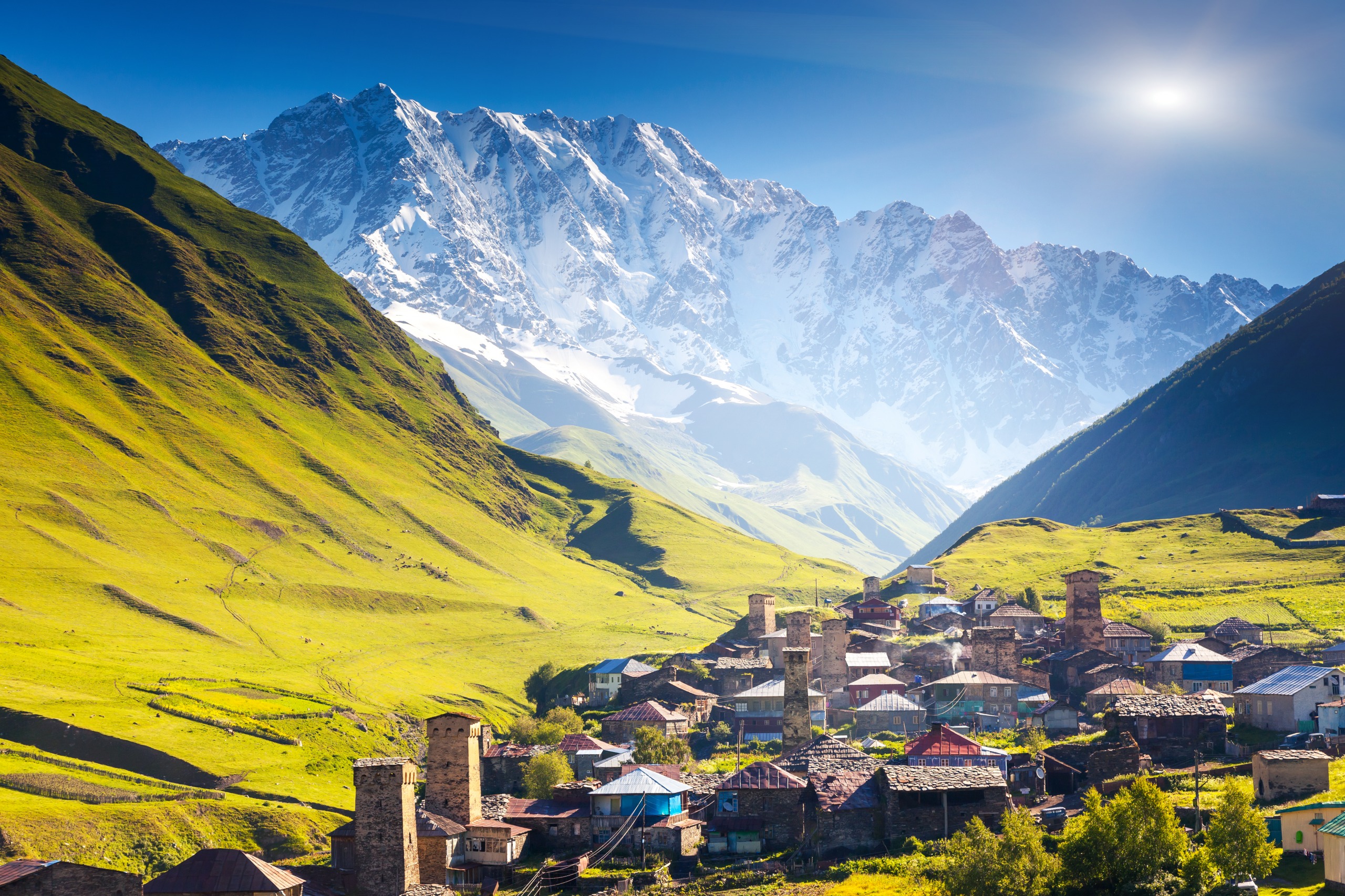
Svanétie
Georgia's most remote region, Svanétie features medieval defensive towers, peaks exceeding 5000 metres, and a Svan culture preserved through six centuries of isolation.
Svanétie occupies the northwestern corner of Géorgie, wedged between the main crest of the Greater Caucasus and the Svaneti massif, with summits surpassing 5000 metres: Chkhara (5193 m), Tetnouldi, and Ouchba with its distinctive twin peaks. To reach this region from Tbilissi, we offer two options: a domestic Vanilla Sky flight to Mestia airfield (45 minutes, weather permitting) or the road via Zougdidi, approximately 8 hours by private vehicle. The final stretch, paved for about a decade, winds through the Enguri Gorge and skirts the Enguri reservoir before climbing in switchbacks to the plateau.
Mestia, at 1500 metres elevation, serves as the base. The town has 1900 residents, two substantial museums (the Museum of History and Ethnography, which preserves medieval icons and manuscripts, and the Mikheil Khergiani house-museum dedicated to the famous Svan mountaineer), and a fabric of stone tower-houses, some dating back to the 12th century. Further down the valley, 47 kilometres away and roughly two hours along a mountain road, the hamlet of Ushguli groups four villages at 2200 metres: Zhibiani, Chvibiani, Chazhashi, and Murkmeli. Chazhashi, with its concentration of defensive towers, has been UNESCO World Heritage listed since 1996.
The Svans speak their own language, Svan, distinct from Georgian though belonging to the same Kartvelian family. It has no official script and is transmitted orally. The territory remained insulated from successive invasions that swept across the Caucasus, which explains the preservation of liturgical objects, icons, and processional crosses hidden in towers for centuries. Local Christianity blends Orthodox rites with pre-Christian survivals, visible during February's Lamproba festival or Kvirikoba in Kala in late July, where rams are still sacrificed before mountain chapels.
Svan cuisine distinguishes itself from the rest of Géorgie through the severity of climate and altitude. Kubdari, a pastry filled with minced beef and local spices (notably Svan salt, a blend of coriander, garlic, fenugreek, and chilli), accompanies meals. Tachmijabi, a potato purée melted with mountain cheese, and chachvdiari, millet polenta, complete the staple fare. Smoked pork and cheeses aged at altitude hold a central place, given the limited vegetable production above 1500 metres.
Landscapes alternate between beech and fir forests up to 1800 metres, alpine meadows dotted with rhododendrons and gentians beyond, then moraines and glaciers. Chalaadi Glacier, accessible in three hours round-trip from Mestia, offers a glimpse of the glacier front at 1900 metres. More demanding, the Koruldi lakes (2700 m) require a full day, with 1200 metres of elevation gain. The four-day trek between Mestia and Ushguli, approximately 60 kilometres and three passes between 2400 and 2700 metres, remains the most travelled traverse in the Georgian Caucasus. We offer it with porters or in autonomous mode depending on your group's profile, with accommodation in local homes in the stopover villages of Zhabeshi, Adishi, and Iprali.
Economically, tourism has replaced much of the transhumant herding since the road opened in 2011 and stable electricity arrived. Family guesthouses have multiplied in Mestia, sometimes at the expense of traditional architecture. Our team works with around fifteen Svan families in hamlets less frequented than central Mestia, to preserve a form of direct hospitality.
To discover
The defensive towers of Ushguli. At 2200 metres, the hamlet of Chazhashi concentrates some twenty stone towers from the 12th and 13th centuries, UNESCO-listed, against the backdrop of year-round snow-capped Chkhara.
Mestia-Ushguli trek in four days. 60 kilometres and three passes around 2700 metres, with nights in local homes in Zhabeshi, Adishi, and Iprali. Glacier crossing by ford between Adishi and Chkhutnieri pass.
Mestia History Museum. Byzantine icons, silver processional crosses, and evangelical manuscripts preserved by the Svans while the rest of the country endured invasions, from the 9th to 15th centuries.
Svan cuisine with locals. Spiced meat kubdari, tachmijabi with melted cheese, and homemade chacha shared in wood-stove kitchens of family guesthouses in Zhabeshi or Latali.
Kvirikoba festival in Kala. On July 28, in the Saint-Quirice chapel of the hamlet of Kala, procession and ritual sacrifices blending Orthodox Christianity with ancient Svan pre-Christian traditions.
When to go
The usable season runs from mid-June to mid-October. Before mid-June, high passes remain snow-covered and the Mestia-Ushguli trek is impracticable, particularly the Chkhutnieri pass (2722 m) and the glacial torrent crossing at Adishi, more dangerous early season due to snowmelt. July and August are the most stable months, with daytime temperatures of 18 to 24°C in Mestia and 8 to 12°C at night, but 5 to 10°C cooler in Ushguli. This is also peak tourist season, with guesthouses full in August, requiring booking months ahead.
September remains our preferred season: still mild days, first autumn colours on beeches from mid-September onwards, lower crowds. From mid-October onwards, first snows can close the Zagar pass between Ushguli and Lentekhi. From December to March, Svanétie becomes a skiing destination (Tetnouldi and Hatsvali stations, open since 2016), but the road from Zougdidi may be cut for several consecutive days and the Tbilissi-Mestia flight is frequently cancelled. We advise against April-May for trekking: thawing snow, washed-out bridges, often cloudy skies.
Practical advice
We recommend 4 to 6 days in Svanétie to justify the 8-hour road journey or weather-dependent flight. A 4-day stay allows Mestia, a day trip to Ushguli with return, and an acclimatisation walk to Koruldi lakes or Chalaadi Glacier. For the complete Mestia-Ushguli trek, allow 6 days minimum, transfers included. The logistical entry point is Mestia airfield (Queen Tamar) for flights, or Zougdidi bus station for the road, reachable by overnight train from Tbilissi.
Svanétie combines well with the Black Sea coast and Adjaria: from Mestia, reach Batumi in 6 hours via Zougdidi, offering a striking contrast between high mountain and subtropical coastline. Also a worthwhile combination with Kazbegui and central Caucasus for trekkers wanting to compare the two sides of the Greater Caucasus, but this means crossing Géorgie west to east again, requiring two days of travel. Comfort remains rustic: family guesthouses with shared bathrooms mostly, a few 3-star hotels in Mestia only. The region suits trekkers, travellers curious about ethnography, and mountain enthusiasts; less suitable for families with very young children due to winding roads and constant elevation changes.