Tbilissi and Surroundings
Our base. A capital in layers between the Narikala fortress, sulfur baths, wine caves of Sololaki and the ancient capital Mtskheta 25 km away.
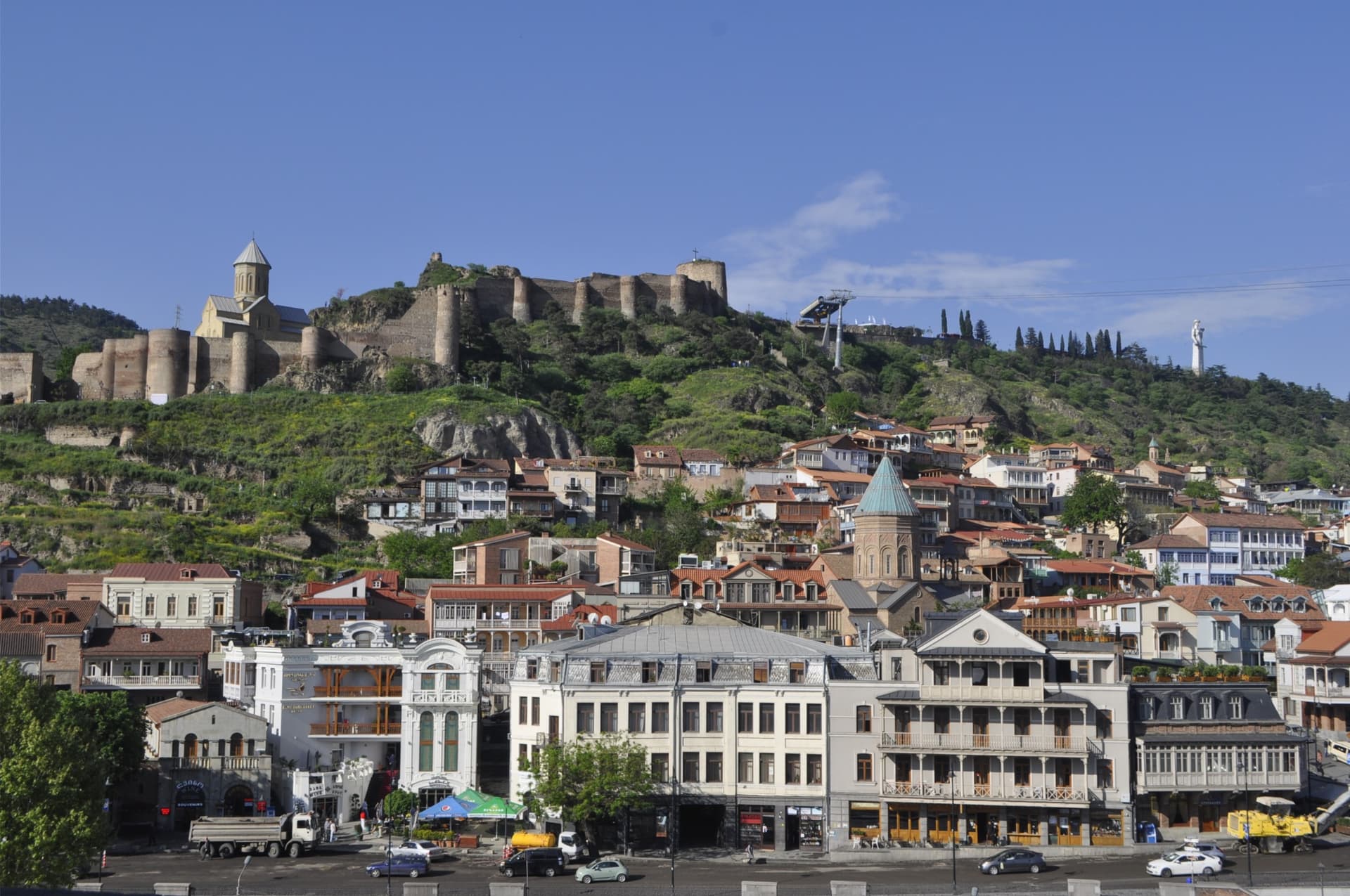
Tbilissi is our base. The city stretches some fifteen kilometers across a basin traversed by the Mtkvari River (Koura in Russian), framed by the Mtatsminda hills to the west and Makhata to the north. The terrain explains everything: the old quarters clung to the southern slopes around the Narikala fortress, built in the 4th century, while Soviet avenues spread across the flat zones of Saburtalo and Vake. This layered topography creates a readable city where you pass in minutes from the cobbled streets of the Betlemi quarter to the straight boulevards of Rustaveli Avenue.
The historic core spans two square kilometers. Abanotubani, the quarter of sulfur baths crowned with brick domes, occupies the valley floor: water emerges at 38-40 degrees Celsius and feeds a dozen establishments, some dating from the 17th century. Nearby, Metekhi Square marks the old caravan crossroads where Persian, Armenian and Russian merchants met. This layering is still legible in the religious buildings of the center, minutes apart from one another: Sioni Cathedral (6th century, rebuilt multiple times), the Sephardic synagogue on Leselidze Street, the Juma Mosque (the only one in the Caucasus to welcome both Sunni and Shia under the same roof), and the Armenian Church of St. George of Norashen.
Sololaki, on the western slope, concentrates the bourgeois apartment buildings from the late 19th century, when Tbilissi prospered as the capital of Russian Caucasia. Frescoed stairwells, stained glass windows and ornate wooden balconies lie in open access for anyone who pushes a carriage door. Higher up, the Mtatsminda quarter is reached by a 1905 funicular and peaks at 770 meters, with its antiquated amusement park and views that stretch to the Lesser Caucasus range on clear days.
Cuisine is serious business here. Wine caves in the center serve saperavi and rkatsiteli vinified in qvevri (buried earthenware vessels, a technique inscribed on UNESCO's list), accompanied by khinkali (large broth-filled dumplings), adjarian khachapuri (boat-shaped bread topped with egg and cheese) and lobio (beans stewed with cilantro). We often guide our travelers toward addresses in Sololaki or Erekle II Street rather than the crowded terraces of Shardeni Street.
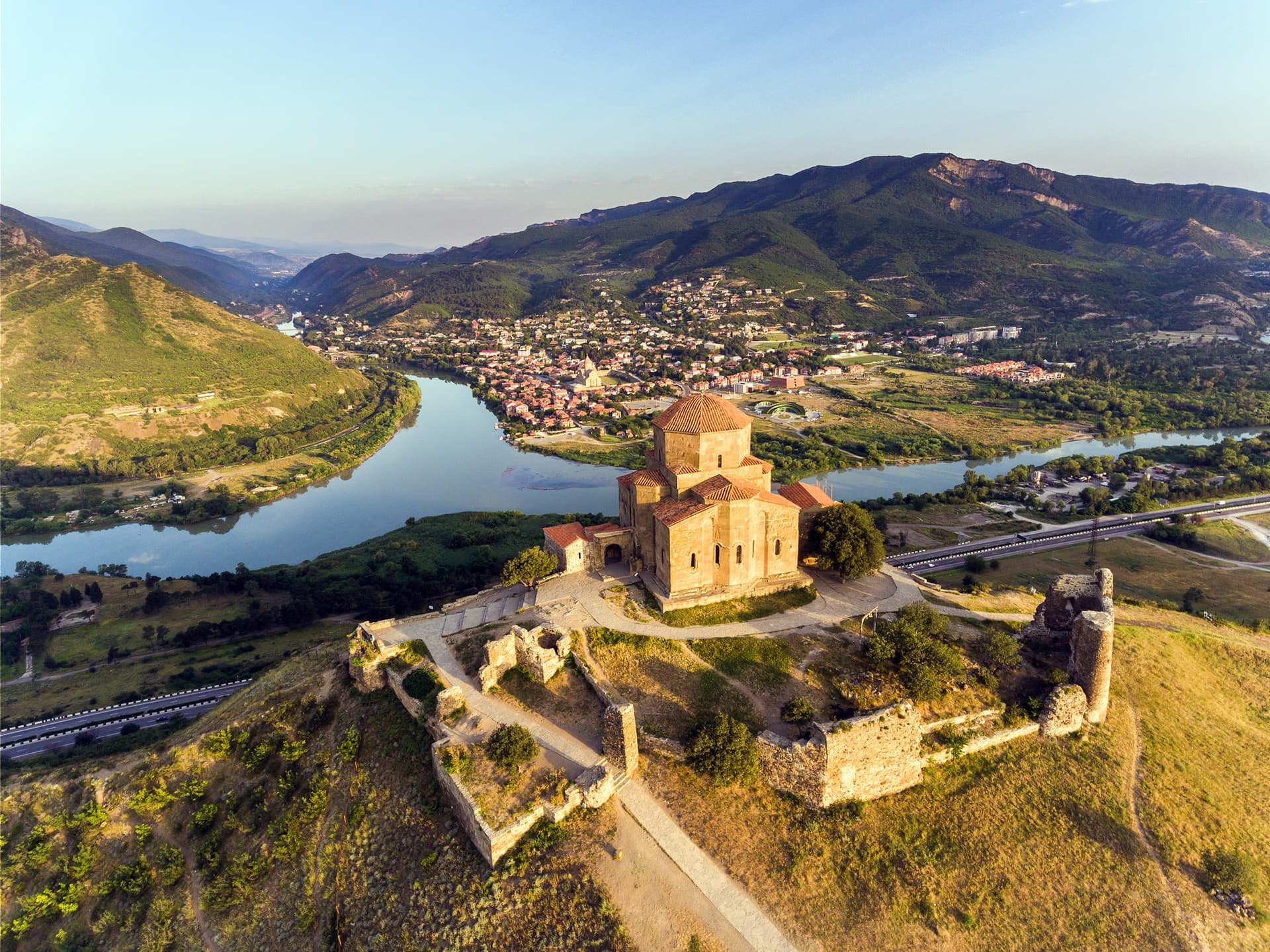
Twenty-five kilometers to the northwest, Mtskheta was the capital of the Kingdom of Iberia for eight centuries and remains the spiritual center of the Georgian Orthodox Church. Svetitskhovleri Cathedral (11th century) is said to house the tunic of Christ and hosts the country's most solemn baptisms and weddings. On the opposite hill, the Jvari Monastery (6th century) overlooks the confluence of the Mtkvari and Aragvi rivers: it is one of the first Christian structures built in Géorgie, following King Mirian's conversion in 337. Sixty kilometers to the south, the ancient rock-cut capital of Uplistsikhe hollows out the northern bank of the Mtkvari across three hectares of rooms carved into sandstone.
Tbilissi has 1.2 million inhabitants—roughly one-third of the country's population. It is a city of cafés, independent galleries (around the rehabilitated Aghmashenebeli Street and the Marjanishvili quarter), and vibrant markets like the Dezerter Bazaar near the central station. For anyone beginning a journey through Géorgie, it is also the place where you grasp the country's codes before heading toward the mountains or vineyards.
To Discover
Abanotubani Sulfur Baths. An hour in a private cabin at 40 degrees beneath 17th-century brick domes, followed by a scrub with a horsehair glove by a kissi. The Orbeliani and Chreli Abano baths remain our favorites.
Mtskheta and Jvari Monastery. A half-day to understand Géorgie's Christianization in the 4th century. From the Jvari terrace, the green and brown confluence of the Mtkvari and Aragvi rivers is plainly visible 150 meters below.
Wine Tasting in a Sololaki Cave. Family-run caves serving qvevri wines produced in Kakheti, accompanied by a supra (Georgian table) with pkhali, badrijani and khinkali. Plan on three hours and one toast per guest.
Uplistsikhe Rock-Cut City. Forty minutes walking through a sandstone-carved city inhabited from the 1st millennium BCE until the 13th century. Banquet halls, an ancient pharmacy and an open-air theater are identifiable.
Dezerter Bazaar Market. Popular market halls near the station where the city's restaurants source supplies: Svanetian spices, braided sulguni cheese, churchkhela (walnuts coated in reduced grape juice), chestnut honey.
When to Go
Tbilissi experiences a semi-continental climate. From May to mid-June and from mid-September to October, temperatures range between 18 and 26 degrees Celsius, with generally clear skies: these are the windows we recommend first. July and August are hot, often 32 to 35 degrees daytime, reaching 38 during peaks, and the basin traps heat until midnight. It is manageable if you accept slowing down between 1pm and 5pm, but uncomfortable for long urban walks.
Winter is mild compared to the rest of the Caucasus, with averages of 2 to 7 degrees between December and February, but humidity and gray skies are frequent, and it rains roughly twenty days a month in winter. Snowfall is rare and melts quickly. March and April remain variable, alternating spring days at 20 degrees with cold snaps and steady rain. In Mtskheta, in the low plain at 470 meters, the climate is identical to Tbilissi's.
Practical Advice
We recommend two to three full days for Tbilissi and an additional half-day for Mtskheta. Beyond that, you can add Uplistsikhe and the city of Gori (Stalin Museum) as a day excursion, extending your stay to four days. Tbilissi's international airport lies 17 kilometers from the center—about 25 minutes by car outside peak hours—and concentrates flights from Europe, Istanbul and Doha. It is the natural entry point for 90% of our travelers.
Tbilissi logically combines with all other regions of the country. To the east, wine-producing Kakheti is 1.5 hours by road (Telavi, Signaghi). To the north, the Georgian Military Road reaches Kazbegi and central Caucasus in 3 hours. For Svaneti, allow a 1-hour domestic flight to Mestia or 9 hours by road via Zugdidi. The Black Sea coast and Batumi are 6 hours via motorway, or 5.5 hours by express train. Borjomi and central Géorgie are reached in 2.5 hours. Hotel comfort in Tbilissi covers the full range, from family guesthouses in Sololaki mansions to international 5-stars. The city suits both architecture and wine enthusiasts and families equally well, keeping in mind that many quarters are steep and cobbled.