Vardzia
Vardzia
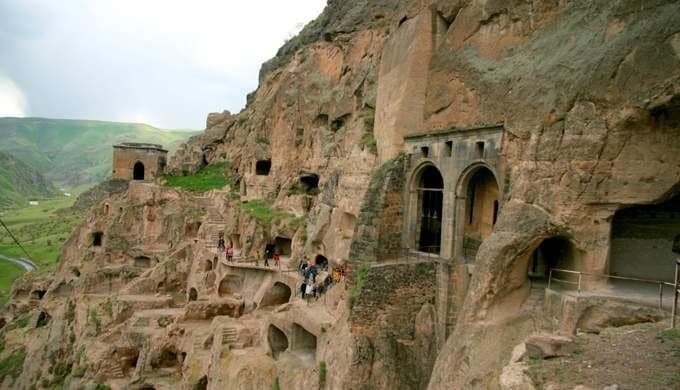
Vardzia is a 12th-century troglodytic monastery-city carved into the volcanic cliffs of southern Géorgie. Frescoes commissioned by Queen Tamar, galleries stretching across thirteen levels, and resident monks make it an exceptional medieval site.
Vardzia is a cave monastery-town carved into the volcanic cliffs of the Mtkvari valley in southern Georgia. Hewn in the 12th century under the reign of Queen Tamar, this complex of several hundred caves is arranged across thirteen levels. It remains one of the most striking testimonies to Georgia's medieval golden age and an active pilgrimage site.
Practical Information at a Glance
Admission: fee required (archaeological site managed by the Georgian state)
Recommended duration: 2 to 3 hours to explore the main galleries and church
Dress code: cover shoulders and knees to enter the Church of the Dormition
Access: paved road from Akhaltsikhe (approximately 70 km); on-site parking
Accessibility for people with reduced mobility: very limited — galleries involve stairs and narrow passages
What to See
The complex contains more than 400 visible chambers: monastic cells, refectories, wine cellars, pharmacies, bathhouses, and communication tunnels. The Church of the Dormition of the Virgin preserves 12th-century frescoes, including a portrait of Queen Tamar considered one of the rare contemporary portraits of the sovereign.
Some of the caves are still inhabited by monks, giving the site a rare living quality for a complex of this age.
History and Context
Construction began under King George III around 1156 and intensified under his daughter Tamar, who reigned from 1184 to 1213. At its peak, Vardzia housed several thousand monks. In 1283, a major earthquake destroyed the cliff face, exposing galleries that were once hidden. Persian forces sacked the site in 1551, ending its period of monastic glory.
Listed on UNESCO's World Heritage tentative list, Vardzia is designated an immovable cultural monument of Georgia.
Highlights of Your Visit
The Church of the Dormition
The spiritual heart of the complex, this rock-cut church preserves a cycle of remarkably well-preserved Byzantine frescoes. The portrait of Tamar, depicted in royal regalia, is the focal point of any visit.
The Gallery Network
Tunnels connect the different levels of the complex. Some passages lead to terraces offering sweeping views of the Mtkvari valley and the gorges below.
The Wine Cellars
Vardzia had its own winemaking facilities. Several vessels (kvevri) carved into the rock are still visible, testifying to the economic self-sufficiency of the medieval monastery.
The Sacred Spring
A freshwater spring flows within the complex. It was considered miraculous and provided the monastery with drinking water.
Etiquette and Visiting Rules
Cover shoulders and knees before entering the church; shawls may be available at the entrance.
Speak in hushed tones in active monastic spaces.
Do not touch the frescoes.
Respect areas reserved for resident monks.
Photography Tips
Morning light illuminates the cliff face and upper galleries directly. In late afternoon, the valley falls into shadow but the warm tones on the volcanic rock are striking. Inside the church, light is dim: a tripod or high ISO sensitivity is necessary. Photography of the frescoes is generally permitted without flash.
Location and Access
Vardzia is located in the Samtskhe-Javakheti region, approximately 70 km southwest of Akhaltsikhe along the road following the Mtkvari. From Tbilisi, allow approximately 5 hours of driving. Marshrutkas (minibuses) connect Akhaltsikhe to Vardzia, but schedules are irregular; a rental car or organized tour remain the most convenient options. Parking is located at the foot of the site, from where a path leads up to the galleries.
Nearby Attractions
Khertvisi Fortress — one of Georgia's oldest fortresses, perched at the confluence of two rivers, about thirty kilometers from Vardzia.
Akhaltsikhe and Rabati Fortress — the main city of the region, with a restored citadel blending Georgian, Ottoman, and Persian architecture.
Tmogvi Fortress — medieval ruins overlooking the Mtkvari gorge, a few kilometers from Vardzia.
Lake Paravani — Georgia's largest lake, in the Javakheti highlands, accessible from Akhaltsikhe.
Frequently asked questions
May to October, when the road is passable and weather is favorable. In July-August, the site is busier. Spring (May-June) offers a good balance between favorable weather and moderate crowds.
Yes, to access the Church of the Dormition: shoulders and knees must be covered. Also wear shoes with non-slip soles, as rocky passages can be slippery.
Yes. Khertvisi Fortress and Tmogvi ruins can be visited on the route from Akhaltsikhe. Allow a full day from Akhaltsikhe to visit all three sites.
No, for the most part. The galleries involve stairs carved into rock, low passages, and significant elevation changes. Accessibility for people with reduced mobility is very limited.
Local guides offer their services at the site entrance. You can also book an English-speaking guide through a local agency in Akhaltsikhe or Tbilisi for a better experience.
Photography without flash is generally permitted. Avoid using flash to prevent damage to medieval fresco pigments and respect any signage displayed on-site.
Want to discover this destination?
Our local advisors design your tailor-made trip.