Dining in Georgia
To awaken your palate, there's nothing quite like savoring a typical meal in Georgia.
To awaken your palate, there's nothing quite like savoring a typical meal in Georgia.
In this small country of the Caucasus, cuisine holds a place of true significance. Eastern, Asian, and even Western influences are woven into the local dishes, prepared with fresh ingredients sourced from the country.
What you should know about Georgian cuisine
By nature, Georgian gastronomy is fresh, generous, and spiced—above all, composed of abundant vegetables.
Generally, nuts form the cornerstone of Georgian gastronomy, as do fresh fruits, bread, and cheeses. As for spices, they bring character to meat dishes.
Due to its political and geographical position, Georgia has, for centuries, absorbed the diverse culinary influences of its neighbors.
Despite this, the country has managed to preserve its identity.
Georgian cuisine contains some influences from the Middle East, Europe, and Asia.
Each historic region possesses its own traditions, with dishes varying across different regional interpretations.
In Western Georgia, for example, influenced by Turkey, dishes are typically made with pork and corn, and notably very spiced.
Conversely, in Eastern Georgia, influenced by Persia, dishes are less heavily spiced. They often feature beef or lamb, with wheat as the primary ingredient.
Georgian cuisine is considered a sharing cuisine. In a country where the guest is perceived as a gift, gastronomy is simply a reflection of the generosity and hospitality of its people. This sentiment manifests primarily during the traditional Georgian feast called the Supra, where conviviality pairs with copious meals and generous quantities of wine.
The Art of the Table in Georgia, a Feast for the Eyes
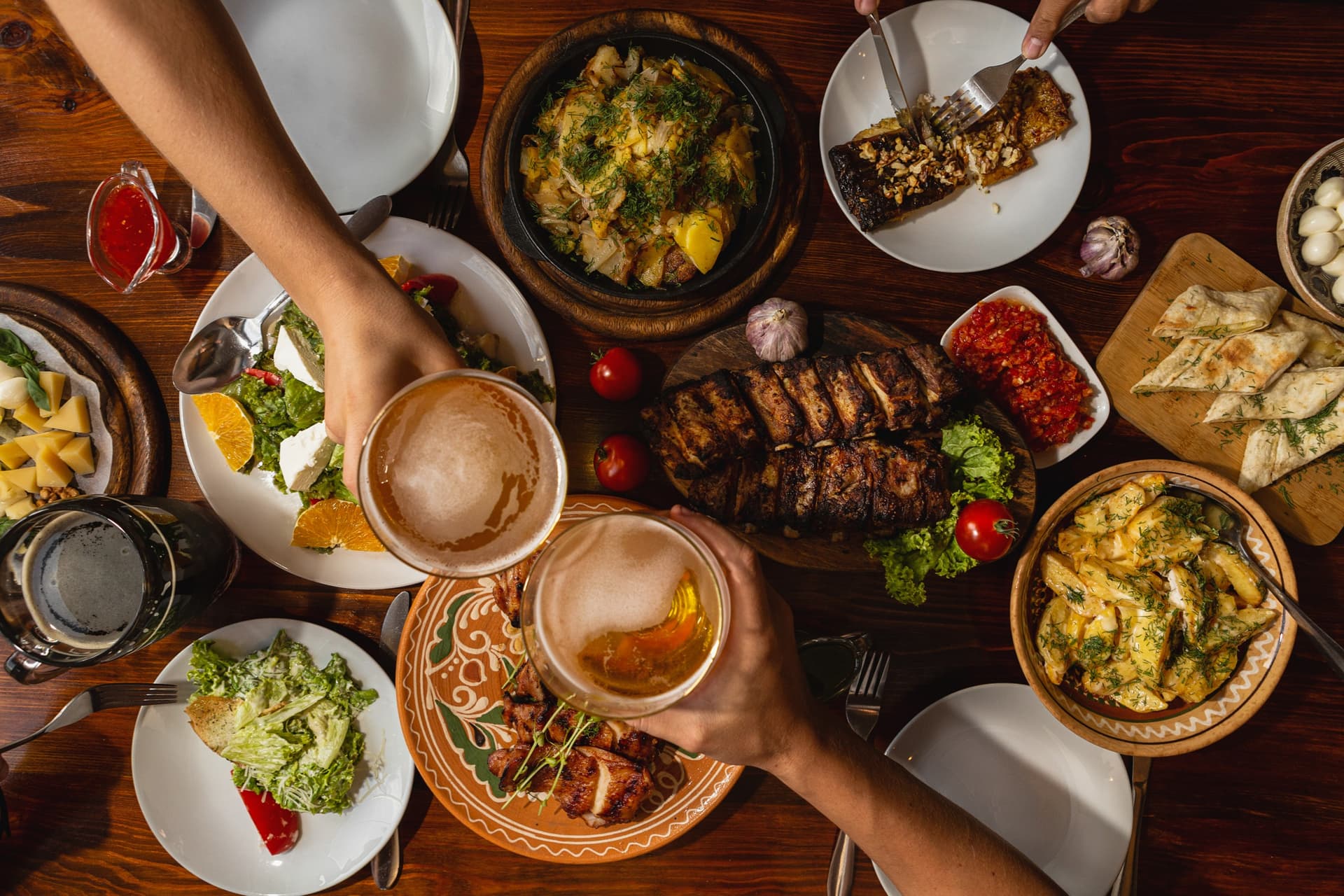
Georgian buffets are extraordinarily abundant, reflecting the generosity of its people.
Dishes are not individual. In fact, each diner serves themselves from a multitude of shared platters placed on the table.
Throughout the meal, dishes continue to arrive, beginning with cold preparations, then hot ones. However, according to local tradition, a fine tablecloth should never be visible. Thus, dishes are only cleared at the end of the meal and pile up on the table.
Each table is dressed with artistry and presents various appetizing preparations.
The whole is complemented by fine Georgian wines.
Should you be invited to a Georgian buffet, don't be surprised if your plate remains full. Indeed, your left and right neighbors, as well as the host and hostess, will ensure your plate stays filled throughout the meal.
For Georgian honor, it is paramount that food remains on the table.
A Georgian considers it impolite for a guest to finish their plate. Also know that Georgians never wish each other "bon appétit".
They love to celebrate and offer toasts, especially during the traditional Supra feast.
Dining Options in Georgia
The "fast-food" dining style is still little-known in Georgia, as Georgians favor the warmth and conviviality of traditional tables.
However, in the capital Tbilisi, you'll find some fast-food establishments offering European and local cuisine.
You'll also see street vendors offering the famous khachapuri, which is cheese-filled bread.
Most restaurants offer relatively lengthy service.
During the meal, the server will regularly change your plate. This is the standard of good service in Georgia.
As a reference, a local beer costs between 2 and 3 lari, with foreign beer ranging from 5 to 8 lari.
As for khachapuri, this dish costs between 6 and 7 lari per person in a restaurant.
Georgian Culinary Specialties to Discover
Appetizers:
Khachapuri is one of the most beloved Georgian dishes abroad and the national traditional dish. This Georgian specialty is a flat, fluffy pastry filled with traditional melting cheese and egg. It is always served hot. The traditional cheese can be replaced with feta or mozzarella.
Khachapuri can be purchased in an upscale restaurant, a café, a supermarket, or on the street as fast-food.
Moreover, this dish comes in different versions, depending on which region you visit.
The most common is Imeruli Khachapuri (from Imereti). This variant is presented as round bread, filled only with cheese.
Another highly popular variant is the Adjarouli, from the coastal region of Adjara. This double-spatula bread is served with a fresh egg in the hollow and butter.
Pomidoris da kitris salati is another typical appetizer to discover and highly appreciated in Georgia.
It is a mixed salad with tomatoes and cucumbers. It is often accompanied by onions, parsley, peppers or chili, and salt.
Meat Dishes:
Khinkali is one of the most renowned Georgian meat dishes. These enormous Georgian dumplings are ubiquitous in local gastronomy. Generally, they are filled with vegetables or ground meat, pepper, herbs, and onions.
Khinkali varieties are defined by different types of meat, including khinkali kalakouri, filled with ground beef or pork.
Another variant to discover is khinkali mokhévé, made with ground lamb. This is a version more common in Georgia's mountainous regions.
Mtsvadi is a meat skewer—a dish you must also taste.
Generally, it's pork, sometimes beef or lamb. Mtsvadi is accompanied by onions. But if you prefer to grill your skewers, you can soak them in pomegranate juice or red wine.
Fish:
Sturgeon, trout, turbot, mullet, and catfish are the undisputed masters of the Georgian table. The dish is coated in a walnut and vinegar sauce.
Moreover, for sturgeon skewers, you can serve them with a mushroom sauce or cook them over coals.
Cheese:
Cheese is another pillar of Georgian gastronomy. While each region has its own specific recipe, the west is known for its cow's milk cheeses, while the east and north are known for their goat's milk cheeses. In contrast, in the mountains, sheep's milk cheese is found on tables.
In the western part of Georgia, you'll find Suluguni and Imerouli. These cheeses have a tangy taste, slightly spiced and fresh.
In eastern Georgia, Goudis and Touchouri, which are very sharp and salty, are highly appreciated. Generally, cheese is savored as an appetizer or during toasts. It also adds more flavor and piquancy to main dishes, salads, and soups.
Soups: Soups are extremely popular in Georgia. Nearly all soups are prepared without vegetables, but served with a flour-based or raw egg vinaigrette.
Georgian soups also have the particularity of being seasoned with wine vinegar, matsoni (fermented dairy product), or fruit juice, which gives them a unique flavor. The most appreciated soups are khashi, chikhirtma, or kharcho. For example, kharcho is a soup made with tklapi (a red plum purée), rice, beef, and walnuts.
Bread:
To accompany most of your dishes, nothing beats traditional Georgian bread:
Lavashi. It is baked in a toné, a special bread oven heated with coals.
Lavashi, featuring a double-spatula shape, is very salty.
Sauces and Spices:
Georgian cuisine uses spices extensively, which come in different forms.
Bajé is a sauce made with walnut oil, onions, cilantro, garlic, salt, and red peppers. It often accompanies salads or main courses like chicken.
Tkemali is a sauce made from seasonal pressed fruits, such as mirabelles. The fruits are salted, then mixed with cilantro. It accompanies several Georgian dishes.
And finally, Tomatis satsébéli is a spicy tomato sauce made with chilies, tomatoes, garlic, and cilantro.
Desserts:
Georgian desserts consist primarily of dried fruits, tarts, walnuts, hazelnuts, or honey.
They are often accompanied by tea or coffee.
However, Churchkhela remains the quintessential Georgian dessert. It is a traditional confection made with walnuts and grapes. This homemade dessert is a sort of "skewer" of nuts (almonds or hazelnuts), which is then dipped in grape juice and finally dried in the sun.
Churchkhela is particularly appreciated during Christmas or New Year's festivities.
Beverages:
Alcoholic:
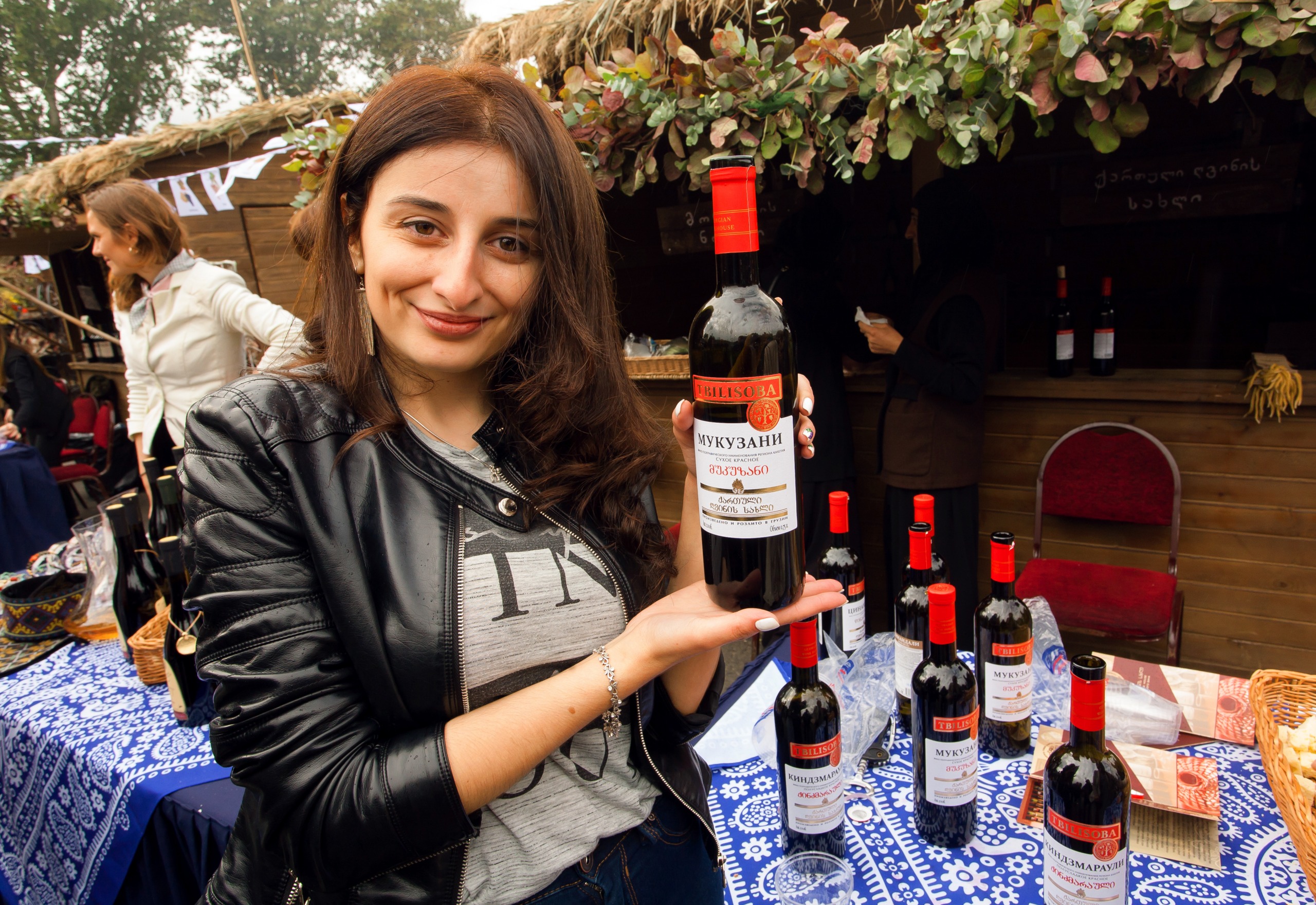
In Georgia, wine is a true institution. According to tradition, whoever drinks wine must obligatorily offer a toast, then empty their glass or kantsi in one go. The kantsi is a horn with a pointed end into which wine is poured.
There are several wines in Georgia, and each family has its own wine. In the dry red wine category, you have Saperavi, Old Tbilisi, or Alexandrouli.
For fruity white wine, try Savané, Manavi, or Tétra.
You also have sparkling white wine, such as Bagrationi, or Khvantchkara, a sweet red wine.
Beyond wine, Tchatcha is the traditional national beverage of Georgia. It is sometimes called "grape vodka," "vine vodka," or "Georgian vodka." Tchatcha is an ancient beverage produced from grape pomace—solid residues resulting from wine production. This drink is odorless, colorless, smooth, rich in aromas, and refined.
Non-Alcoholic:
Lemonades are highly prized in Georgia. They come in fruity flavors (peach, lemon, etc.).
You also have Georgian mineral waters, with their unique taste.
The Supra, an Essential Part of Georgian Gastronomy
The Supra is a traditional Georgian banquet. It is a ritual that holds a major place in the country's culture.
Its origins trace back to Ancient Greece, particularly to the era of Pluton and the symposion (the festive meal among the Greeks).
There are 2 types of Supra in Georgia:
the Keipi (for weddings, births, birthdays, etc.) and the Kelekhi (for funerals).
The buffets, punctuated by toasts, are generally very abundant and lively.
Some hosts even go without to satisfy their guests. The grand table consists of various dishes arranged without particular order.
During the supra, speeches, dances, and songs succeed one another, all under the authority of the Tamada, who is the table master appointed for the occasion. He is the one who delivers speeches or toasts and also invites guests to speak.
Dishes are generally brought during the toasts.
It is forbidden to drink your glass before a toast has been made. Afterward, the glass must be drained in one go.
A successful toast evokes various themes, such as health, friendship, business success, happiness... If you are invited to a banquet, you will be invited to make a toast, and no refusal will be tolerated.
No rules are imposed regarding the number of guests or the location of the banquet.
The purpose of these meals is to open up or encourage everyone to express themselves.