Baku
Baku
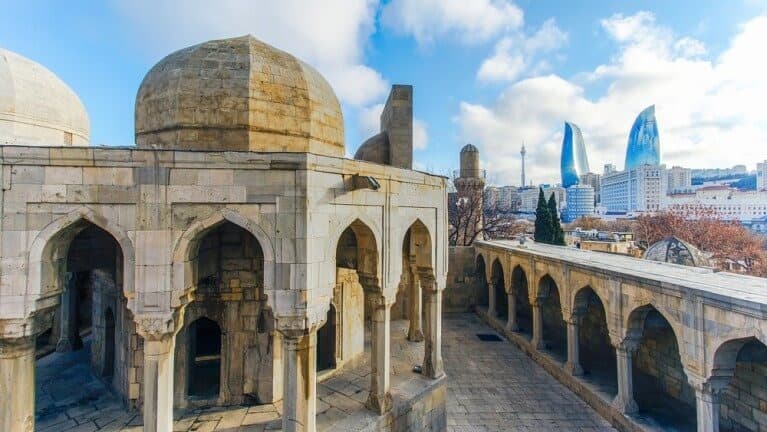
Baku juxtaposes a medieval UNESCO-listed Old City, flame-shaped skyscrapers and a boulevard along the Caspian Sea. A dense capital, between the Caucasus and modernity.
Baku is the capital of Azerbaijan, situated on the western shore of the Caspian Sea. The city juxtaposes a medieval Old City listed by UNESCO, futuristic flame-shaped towers and a revitalized waterfront. A crossroads between Eastern Europe and Central Asia, it concentrates Ottoman, Soviet and contemporary architecture within a compact perimeter, making it a dense and surprising stop for anyone crossing the Caucasus.
Practical Information at a Glance
Airport access: Heydar Aliyev International Airport is connected to the center by taxi, bus and metro (Koroghlu station).
City transport: efficient Soviet-era metro, buses, taxis via app (Bolt available).
Currency: Azerbaijani manat (AZN); credit cards are accepted in most hotels and restaurants.
Language: Azerbaijani; Russian is widely understood; English is growing in tourist areas.
Dress code: modest dress required in mosques (shoulders and knees covered, shoes removed).
Recommended duration: 2 to 3 days to cover the historic center and immediate surroundings.
What to See
Baku's heart divides into two distinct zones. The Old City (İçərişəhər), inscribed on UNESCO's World Heritage list, contains the Maiden Tower, the Shirvanshahs' Palace and a maze of limestone alleyways. A few hundred meters away, the Flame Towers dominate the nighttime skyline with their LED facades. The seafront boulevard (Bulvar) runs along the Caspian for several kilometers.
History and Context
Baku has been inhabited since antiquity, but it was in the 12th century that it emerged as the capital of the Shirvan kingdom. The discovery of oil in the 19th century radically transformed the city: colossal fortunes funded neo-Gothic and neo-Renaissance palaces still visible in the center. Incorporated into the USSR in 1920, Baku inherited massive Soviet architecture. Since independence in 1991, a new wave of construction has redrawn the skyline.
Highlights of Your Visit
The Old City (İçərişəhər)
A fortified enclosure from the 12th century, the Old City concentrates mosques, caravanserais and artisan workshops. The narrow beige limestone alleyways invite wandering. Entry to the enclosure is free; some interior monuments require admission.
The Maiden Tower (Qız Qalası)
A 29-meter cylindrical tower whose origins remain debated — defensive, Zoroastrian or astronomical. From its summit, it offers a panoramic view over Baku Bay and the Old City rooftops.
The Shirvanshahs' Palace
A 15th-century palatial complex comprising a throne room, mosque, mausoleum and bathhouse. It is one of the best-preserved medieval monuments of the South Caucasus.
The Flame Towers
Three flame-shaped skyscrapers reaching over 180 meters. At night, their LED facades recreate animated flames, a direct reference to Azerbaijan's historic status as the "Land of Fire."
The Seafront Boulevard (Bulvar)
A revitalized promenade along the Caspian, dotted with gardens, cafés and cultural spaces. Ideal in the evening to observe the illuminated city from the shore.
The Azerbaijan Carpet Museum
A building shaped like a rolled carpet housing a collection of Caucasian carpets from the 17th century to today. The building's architecture itself is a curiosity.
Etiquette and Visiting Rules
In mosques: cover shoulders and knees, remove your shoes at the entrance.
Women must cover their hair in prayer areas.
Avoid beach attire in the Old City out of respect for the residential neighborhood.
Photography is generally allowed in public spaces; check restrictions inside museums.
Photography Tips
The golden evening light enhances the limestone of the Old City. For the Flame Towers, favor nightfall from the boulevard or from the hill behind the Shirvanshahs' Palace. The Maiden Tower photographs well from the square below in late afternoon. The Old City rooftops offer unique angles if you can access terraces at certain cafés.
Location and Access
Baku occupies the Absheron Peninsula, on the western coast of the Caspian Sea. The historic center is compact and largely pedestrian. The metro serves the main neighborhoods; the Old City is reached on foot from the İçərişəhər station, the oldest in the network. Rail connections link Baku to Tbilisi (Georgia) on an overnight train.
Nearby Attractions
Gobustan — site of prehistoric petroglyphs and mud volcanoes, about 60 km southwest of Baku.
Ateshgah Fire Temple — ancient Zoroastrian temple fed by natural gas fires, on the Absheron Peninsula.
Yanar Dag — permanently burning hillside due to natural gas emissions, spectacular at nightfall.
Sheki — historic city in northwestern Azerbaijan, known for its khans' palace and leaded glass windows.
Frequently asked questions
Spring (April-May) and autumn (September-October) offer pleasant temperatures. Summer can be very hot and windy on the Absheron Peninsula; winter is mild but rainy.
Most European nationals can obtain an e-visa online before departure via the official Azerbaijani portal. Check conditions according to your nationality before traveling.
Allow half a day for a free visit to the Old City, a full day if you include the Shirvanshahs' Palace and Maiden Tower with their interiors.
Yes. An overnight train connects Baku to Tbilisi. It is common to combine Azerbaijan, Georgia and Armenia in a two to three-week circuit.
It is generally tolerated in courtyards and exterior spaces, but often forbidden or at the discretion of staff in prayer halls. Always ask permission on site.
Plov (saffron rice and meat), dushbara (small dumplings in broth), lavangi (chicken or fish stuffed with walnuts) and kebabs are essential to Azerbaijani cuisine.
Want to discover this destination?
Our local advisors design your tailor-made trip.