Georgia's Entry into the Middle Ages
Georgia's Entry into the Middle Ages
The eastern part of Georgia undergoes considerable transformation in the 4th century.
Iberia shifts from Parthian vassalage to Persian vassalage (Sassanid), while also becoming an integral part of Rome.
During the 330s, Saint Nino of Cappadocia, a nun from Jerusalem descended from the family of George of Lydda, converts King Mirian III and his wife to Christianity.
The end of the 5th century is marked by the first attempt to unify Iberia with Colchis.
Following the death of King Vakhtang I, around 580, Persia invades eastern Georgia, which becomes a province.
A turbulent period ensues for Georgia. On several occasions, it is partitioned between the Byzantines, the Persians, and the Arabs.
By the end of the 9th century, the Prince of Tao, Adarnasé IV, likely supported by his Armenian neighbor, unifies eastern Georgia. At the same time, he assumes the title of "King of the Georgians".
Georgia, Between Persia and Byzantium
Around 450: A peace treaty is concluded between Rome and the King of the Lazes, Goubazes I.
Around 480: Construction of the first Georgian monastery of the Holy Cross by Peter the Iberian (409–490).
The building is located near Jerusalem.
452–502: Reign of Vartang Gorgasal, literally meaning "wolf's head" in Kartli.
He attempts to unify Georgia without great success, but also strives to free himself from the dual Byzantine and Persian tutelage. To break free from Byzantine authority, he proclaims the Churches of eastern and western Georgia as reunified and autocephalous.
He expels bishops appointed by Byzantium and replaces them with 13 new bishops entirely devoted to King Vartang Gorgasal.
Subsequently, he subjugates the mountain tribes and secures Georgia's northern borders by waging war against the Huns and the Alans.
456: Violent repression breaks out against Byzantine occupation, initiated by the Lazes of Colchis.
470: Martyrdom of Saint Shushanik, wife of a local hierarch. She had refused to convert to Zoroastrianism (the first Persian monotheistic religion).
Around 480: Foundation of Tbilisi by Vartang Gorgasal, which literally means the "warm city". However, Mtskheta retains its status as the religious capital.
It is also during this period that eastern Georgia (Iberia) becomes an ally of Persia.
483: The Georgians rise up under King Vartang Gorgasal. A peace treaty is also signed with Persia, which recognizes Georgian autonomy.
484: Separation of the Churches of Rome from those of Byzantium.
488: King Vartang, who dies in 502, is defeated by the Persians.
Around 510: Tbilisi becomes the capital of the Kingdom of Iberia.
532: Treaty of "Eternal Peace" between Persia and Byzantium, who will partition Iberia, dividing it in two.
The eastern part, comprising Tbilisi and the title of king, is granted to Vartang's eldest son, Vatché II.
His younger half-brothers, Levan and Mihrdat, receive the western kingdom, along with the title of archdukes.
Around 550: King Pharsaman V of Iberia officially accepts Persian suzerainty. In exchange, he preserves his country and the Christian religion. However, the Sassanids do not truly honor their part of the agreement. Within years, they annex lower Iberia where Tbilisi is located.
562: Signing of the Treaty of Dara, in which the Persians renounce their claim to western Georgia (Lazica).
Persian Domination
580: Death of King Bakur III of Iberia. Transcaucasia is entirely integrated into the Sassanid Persian Empire.
588: The Iberian population, with the support of the nobility, revolts against the tyranny of Shah Hormizd IV (579–590). They call upon Georgian Prince Gouaram, who had taken refuge in Lazica since the Persian occupation, to rule the Kingdom of Iberia.
He accepts, taking the title of Prince-Primate instead of King of Iberia.
Stephanos I (590–627), his successor, finds himself engaged in several wars between the Sassanids and Byzantines early in his reign.
Around 600: Iberia regains its political autonomy.
In 610: Separation of the Georgian and Armenian Churches under Catholicos Kyriakos I (595–610). Acceptance of Orthodoxy by the Church of eastern Georgia.
In 610: A new dynasty is established in Byzantium by Emperor Heraclius, of Armenian origin.
In 624: The Khazars, allies of the Byzantines, destroy and capture Tbilisi. They drive the Persians out of Kartli or eastern Georgia. The Khazars are a mounted people of Asian origin, partially converted to Judaism. They control all conquered territories from the Volga to the Sea of Azov. With their help, the Byzantines easily invade eastern Georgia and conquer, over a brief period, the entire Caucasus.
In 628: The Byzantine Empire establishes its dominion over Georgia and Armenia.
Arab Domination in Georgia
In 634: Having reached Sassanid borders, Muslims begin gradually annexing the Persian Sassanid empire. This annexation lasts until 651.
By 650, Prince-Primate Stephanos II accepts Arab domination over his domains. After a brief Byzantine transition, Iberia becomes a vassal region of the Umayyad Caliphate.
In 654: The Arabs invade eastern Georgia, Albania, and Armenia. Western Georgia remains under Byzantine rule. The Kingdom of Lazica is the only one to escape the Arabs.
In 655: Signing of the Treaty of Maslama: The Arabs must respect religious practices in exchange for recognition of the Caliph's authority and payment of tribute.
From 663–748: During the long reign of Artchil I, the Georgian kingdoms benefit from a period of relative calm and internal growth. Alliances form between the princely family and nobility, and numerous Christian churches are built.
The construction of these churches symbolizes Georgia's refusal to make Islam a state religion. Unfortunately, this provokes a new series of Arab attacks on Iberia and the death of Artchil I, who becomes a "Martyr".
In 685: Thanks to an alliance between the Khazars and Byzantium, the Arabs are quickly expelled.
Byzantium regains control of eastern Georgia and Armenia.
697: The Kingdom of Lazica falls under Arab domination.
735: Foundation of the Emirate of Tbilisi.
736: The Arabs launch a new attack in the Caucasus and regain control of Armenia, Kartli, and Albania.
741: Princes David and Constantine become "Martyrs".
750: The Abbasid dynasty intensifies Arab Caliphate occupation of the Caucasus and strengthens persecution of Christians.
780: Prince of Abkhazia Leo II plans to ally with the Khazars to free himself from Byzantine tutelage. This is also the year of the disappearance of the Kingdom of Lazica, making Abkhazia the dominant kingdom in western Georgia. The Caliphate's authority in eastern Georgia disintegrates.
In 786, the Bagratid dynasty ascends to the throne of Iberia in the person of Ashot I.
He decides to free himself from Arab domination in Georgia.
888 (or 899) marks a new era for the Georgian nation. This is when Prince Adarnasé IV of Iberia assumes the title of "King of the Georgians". His reign is marked by the first-time use of the name "Georgia" in a royal title.
However, the dominion of the Kingdom of Abkhazia ends with the advent of David the Great.
Unification of the Georgian State
In the mid-10th century: The Georgian Orthodox Church, escaping the patriarchate of Constantinople, is reorganized. It asserts its autocephalous character.
966–978: Reign of David III, son of Adarnasé V of Iberia, from the junior branch of the Bagratid dynasty, over Tao-Klarjeti and Kartli. This dynasty rules Georgia, as well as Armenia.
David III Bagration, nicknamed "the Great", upon the death of his father Adarnasé V, becomes king of the hereditary province of Tao-Klarjeti in 966. He simultaneously receives the distinction of Curopalate of Iberia as a courtesy, since Iberia is still under Abkhazian domination.
His reign is primarily marked by the subjugation, within years, of Muslim states bordering his kingdom.
Becoming a great regional power, notably in 976, David III manages to make Byzantine Emperor Basil II his ally. Moreover, Basil II consents to Georgia's independence.
978: Coronation of Bagrat III, adopted son of David III, he is sovereign of both Kartli, Tao-Klarjeti, and Abkhazia.
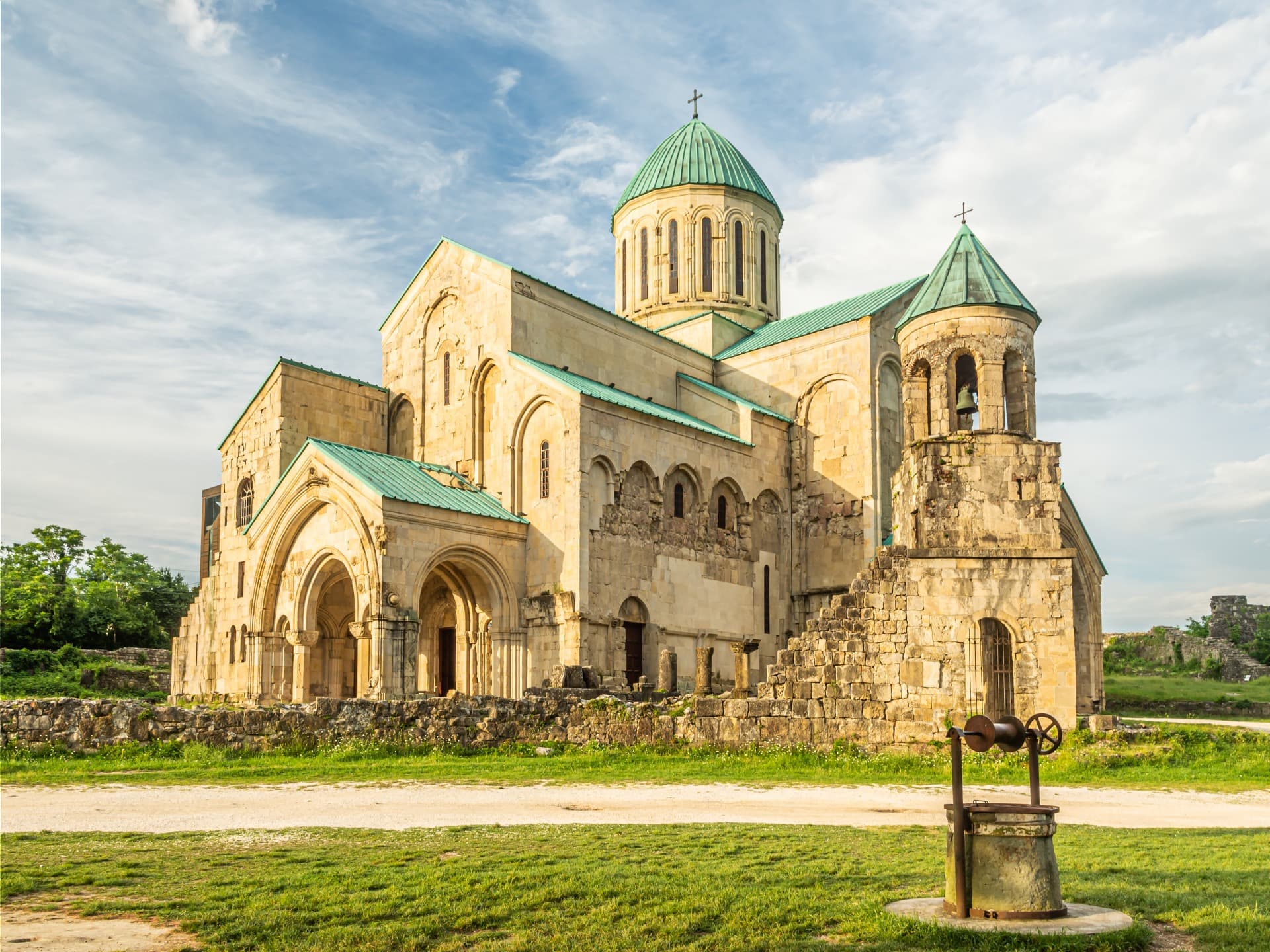
Bagrat III establishes, upon ascending the throne, his capital in the city of Kutaisi, Tbilisi still being under Muslim domination.
He subdues the Emirate of Ganja, assures Byzantium of his loyalty, and renews the family alliance with Armenia. By unifying thus the West and Center of Georgia, he increases his power, arousing the jealousy of his protector, David III Bagration.
In 1008: Iberia and the Kingdom of Georgia fall entirely into the hands of Prince Bagrat III upon the death of his natural father Gurgen I.
Encouraged by his exploits, Bagrat III undertakes a military campaign against the principality of Kakheti, which surrenders in 1010.
At this period, Georgia's unification is a true feat. For the first time, the entire Georgian nation is united, except for Tao, which is now Byzantine.
Moreover, the royal scepter bears the title of "King of the Kartvels, of the Abkhazians, of the Kakhs, and of the Rans".
1014: Death of Bagrat III, wishing to be buried in the Monastery of Bedia, in Abkhazia.
The goal is to mark the lasting annexation of this province to the Georgian kingdom.
For the first time in its history, Georgia is reunified.
1014–1027: Reign of George I, marked by the loss of Kakheti and Tao-Klarjeti.
1027–1072: His son, King Bagrat IV, faces the insurrection of his vassals, led by General Liparit Orbeli.
End of the 10th century: Religious unification between the Primate of Abkhazia and the Catholicos of Georgia, genesis of Georgian unity.
1060: King Bagrat IV forms a family alliance with Seljuk Sultan Alp Arslan. He gives his niece in marriage for this purpose.
1065: The Seljuk Turks occupy Georgia.
1068: The second Seljuk invasion destroys Tbilisi, the provinces of Argveti and Kartli.
1071: With Georgian support, the Seljuks are victorious against the Byzantine army at Manzikert. This victory is marked by the capture of Emperor Romanos IV Diogenes.
This battle marks the end of Byzantine tutelage over Anatolia.
1073: Giorgi II becomes King of Georgia. At this same date, Seljuk Sultan Malik Shah occupies Georgia and sacks the capital Kutaisi.
1074: A Turkish-Georgian peace, to the advantage of the Seljuks, is proclaimed. Georgia must, however, cede to the Turks part of its eastern provinces.
Apex and Georgia's Golden Age
In 1089, a Council of the Nobility decides the fate of Georgia. Upon conclusion of this Council, it is decided that King George II will be stripped of power. He must abdicate in favor of his young son David IV, then only 16 years old.
1089–1125: Epic reign of King David IV the Builder, considered a powerful king and "restorer of Georgian unity."
He expels the Seljuk Turks from Georgia, subjugates feudal lords, and extends his kingdom's influence over the entire Caucasus.
He reforms institutions and the military. He also unites spiritual and temporal power under his rule. This marks the beginning of Georgia's Golden Age.
1103: King David IV ensures direct control over Church affairs and associates them with the direction of national matters. Thus, the Georgian Orthodox Church transforms into an effective instrument serving the State, which is under construction.
In return, the Church receives considerable advantages, including tax benefits granted to high Church dignitaries.
David IV creates a centralized and modern administration.
Administrative heads, attached to the royal court and called "Oukhotsessi", have control over major administrative departments, such as finances, internal affairs, and the military.
The king appoints a "mtsignobarth oukoutsessi", a sort of Prime Minister.
The judicial administration is also reformed.
The Reconquest Under King David IV the Reconstructor
1118: Creation of a standing army that David IV decides to recruit among his loyal neighbors from the North Caucasus mountains, the Kipchaks.
This standing army consists of 50,000 men.
The recruitment of this army enables the reconquest of southern Georgia's lands.
The Armenian conquest begins with the seizure of Lori from the former Georgian suzerains.
1121: The Seljuk Sultan of Khorasan, Mahmud II, declares holy war (jihad) against David IV.
In August of the same year, a powerful army of Muslim soldiers invades Georgia. However, this invasion proves a failure when the army is defeated on August 12, 1121, in a decisive battle at Didgori.
1122: Tbilisi is liberated, after 4 centuries under Arab rule. Its ascension to the rank of capital of unified Georgia is a turning point in the nation's history.
1123: David IV annexes northern Armenia. This annexation is marked by the entry of Georgian troops into Ani, the historical capital of Armenia. It has been under Muslim rule since 1050.
This year also marks Georgian occupation of all Muslim principalities of the Caucasus, Ran and Darubandi, as well as the expulsion of the Seljuks from their final strongholds in Armenia.
January 24, 1125: Death of David IV, or "David IV the Reconstructor", at age 51, who would later be canonized by the Georgian Orthodox Church. He remains to this day a major figure in Georgian history.